


Page 84 - All About History - Issue 34-16
P. 84
Through History


                            NAVIGATION


        Today, finding your way is as simple as taking out your phone. But before the

        dawn of GPS, people had to find their way using just the Sun and stars. See how
        navigation has changed over the years


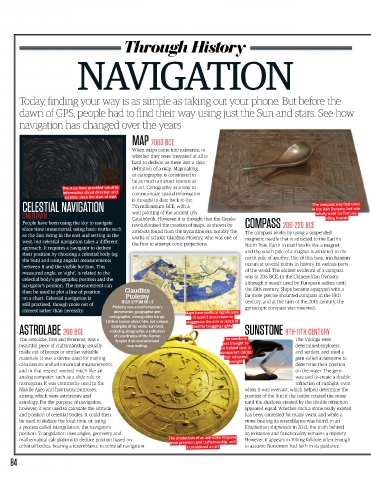
                                               MAP 7000 BCE
                                               When maps came into existence, o
                                               whether they were ‘invented’ at all
                                               hard to deduce, as there isn’t a clea
                                               definition of a map. Mapmaking,
                                               or cartography, is considered to
                                               be as much an exact science as
                       The stars have provided valuable   an art. Cartography as a way to
                       information about direction and   communicate spatial information
                        location since the start of man  is thought to date back to the
         CELESTIAL NAVIGATION                  7th millennium BCE, with a                                      The compass was first used
                                                                                                               in the Han Dynasty, but was
         UNKNOWN                               wall painting of the ancient city                                initially used for fortune-
                                                                                                                   telling boards
                                               Çatalhöyük. However, it is thought that the Greeks
         People have been using the sky to navigate  revolutionised the creation of maps, as shown by  COMPASS 206 220 BCE
         since time immemorial, using basic truths such  artefacts found from the Byzantine era, notably the
         as the Sun rising in the east and setting in the  works of scholar Claudius Ptolemy, who was one of  The compass works by using a suspended
         west, but celestial navigation takes a different  the first to attempt conic projections.  magnetic needle that is attracted to the Earth’s
         approach. It requires a navigator to deduce                                   North Pole. Earth in itself works like a magnet,
         their position by choosing a celestial body (eg                               and the south pole of a magnet is attracted to the
         the Sun) and using angular measurements                                       north pole of another. Use of this basic mechanism
         between it and the visible horizon. This                                      occurs at several points in history, in various parts
         measured angle, or ‘sight’, is related to the                                 of the world. The earliest evidence of a compass
         celestial body’s geographic position and the                                  was in 206 BCE, in the Chinese Han Dynasty,
         navigator’s position. The measurement can                                     although it wasn’t used by European sailors until
         then be used to plot a line of position  Claudius                             the 13th century. Ships became equipped with a
         on a chart. Celestial navigation is  Ptolemy                                  far more precise mounted compass in the 19th
                                            GRECO-EGYPTIAN 100-170
         still practised, though more out of  Ptolemy was a mathematician,             century, and at the turn of the 20th century, the
         interest rather than necessity.  astronomer, geographer and   Maps have political significance   gyroscopic compass was invented.
                                       cartographer, among other things.   – it wasn’t uncommon to
                                      Little is known about him, but various   exaggerate the size or reach of
                                        examples of his works survived,   land for bragging rights
        ASTROLABE 200 BCE               including Geographia, a collection             SUNSTONE 8TH 11TH CENTURY
        The astrolabe, first and foremost, was a  of coordinates of the Roman   The sunstone             The Vikings were
                                          Empire that revolutionised
                                                                               was thought to
        beautiful piece of craftsmanship, usually  map making.                 be Iceland spar, a        determined explorers
        made out of bronze or similar valuable                                transparent calcite        and settlers, and used a
        materials. It was a device used for making                              that refracted           gem called a sunstone to
                                                                                 sunlight
        calculations and astronomical measurements,                                                      determine their position
        and in that respect worked much like an                                                          on the water. The gem
        analog computer, such as a slide rule or                                                         was said to create a double
        nomogram. It was commonly used in the                                                            refraction of sunlight, even
        Middle Ages and had many purposes,                                             when it was overcast, which helped determine the
        among which were astronomy and                                                 position of the Sun if the holder rotated the stone
        astrology. For the purpose of navigation,                                      until the shadows created by the double refraction
        however, it was used to calculate the altitude                                 appeared equal. Whether such a stone really existed
        and position of celestial bodies. It could then                                has been contested for many years, and while a
        be used to deduce the local time, or, using                                    stone bearing its resemblance was found in an
        a process called triangulation, the navigator’s                                Elizabethan shipwreck in 2013, the truth behind
        position. Triangulation uses angles, geometry and                              its existence and functionality remains a mystery.
        mathematical calculations to deduce position based on  The production of an astrolabe requires   However, it appears in Viking folklore often enough
                                                            great precision and craftsmanship, and
        celestial bodies, bearing a resemblance to celestial navigation.  is considered an art  to assume Norsemen had faith in its guidance.
     84

