


Page 36 - (DK Eyewitness) Travel Guide - Scotland
P. 36
34 i NTRODUC i NG SC O TLAND a por tr ait of sc o tland 35
Highland Music and Games Highland Games and Activities
As well as music, the Highlands of Scot land are
The highlands and islands of Scotland have been the famous for their Games. The first Games took
focus of Gaelic culture for hundreds of years. Although place many hundreds of years ago, and may
the language itself is little spoken today, the legacy of have served a military pur pose by allowing clan
the Gaelic lifestyle lives on in the music and activities chiefs to choose the strongest men from those
competing in contests of strength. Highland
of the people. The bagpipes, a traditional highland Games are held annually at Braemar (see p42),
instrument, are an important part of Scotland’s identity as well as at Oban and Dunoon, among others.
around the world, and the highland Games are an Another activity in the Highlands is the
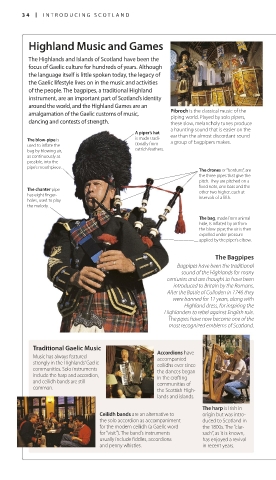
amalgamation of the Gaelic customs of music, Pibroch is the classical music of the Re-enacting Highland battles is re-enactment of past battles and rebellions.
piping world. Played by solo pipers,
popular with modern-day clansmen
dancing and contests of strength. these slow, melancholy tunes produce to commemorate their forefathers’
a haunting sound that is easier on the fight for free dom. The above is a
A piper’s hat ear than the almost discordant sound
The blow-pipe is is made tradi a group of bagpipers makes. re-enactment of red coat soldiers
used to inflate the tionally from charging the Highlanders at the
bag by blowing air, ostrich feathers. Battle of Culloden, where over
as continuously as 2,000 Highland warriors died.
possible, into the
pipe’s mouthpiece.
The drones or “borduns”, are
the three pipes that give the
pitch. They are pitched on a
fixed note, one bass and the
The chanter pipe other two higher, each at
has eight finger intervals of a fifth.
holes, used to play
the melody. The Highland Games (or Gatherings) as they are played today
date from the 1820s. The most common contests and events are
The bag, made from animal tossing the caber, weight shifting, piping, singing, dancing and
hide, is inflated by air from throwing the hammer. The result is a cacophany of sound and
the blowpipe; the air is then activity, which can be overwhelming to a first-time spectator.
expelled under pressure
ap plied by the piper’s elbow.
Throwing the hammer
involves revolving on the
The Bagpipes spot to gather speed, while
swinging the hammer
Bagpipes have been the traditional (a weight on the end of a
sound of the High lands for many long pole) around the head,
centuries and are thought to have been Tossing the caber is be fore launching it across
introduced to Britain by the Romans. one of the most famous the field. The winner is the
After the Battle of Culloden in 1746 they Highland sports, and con testant whose hammer
were banned for 11 years, along with requires strength and rea ches the furthest distance.
Highland dress, for inspiring the skill. The athlete must run
Highlanders to rebel against English rule. with the tree trunk and
toss it so that it flips over
The pipes have now become one of the 180° and lands ver tically,
most recognized emblems of Scotland. straight ahead.
Traditional Gaelic Music
Music has always featured Accordions have
accompanied
strongly in the Highlands’ Gaelic ceilidhs ever since
communities. Solo instruments the dances began
include the harp and accordion, in the crofting
and ceilidh bands are still communities of
common. the Scottish High
lands and islands.
The harp is Irish in
Ceilidh bands are an alternative to origin but was intro Weight shifting is a severe test of
the solo accordion as accompaniment duced to Scotland in strength and stamina. Here, the man
for the modern ceilidh (a Gaelic word the 1800s. The ”clar stands with his back to a bar, over
for “visit”). The band’s instruments sach”, as it is known, Highland dancing is an important part of the Games, and the which he must throw the huge
usually include fiddles, accordions has enjoyed a revi val dances often have symbolic meanings – for instance the circle weight. The bar is raised after each
and penny whistles. in recent years. in a reel represents the circle of life. In the sword dance, the successful attempt, until only one
feet skip nimbly over the swords without touching them. person is left in the competition.
034-035_EW_Scotland.indd 34 04/11/15 10:02 am 034-035_EW_Scotland.indd 35 04/11/15 10:02 am

