


Page 144 - (DK) The Business Book
P. 144
142 WHO BEARS THE RISK?


        Suppliers are among the last to receive
        compensation for their goods or services
        if a business goes bankrupt. If, in the
        UK, it enters “pre-pack administration,”
        suppliers might receive nothing at all.


        liabilities. This method can be
        especially controversial, since it
        can allow the owners of the original
        business to sell the “pre-packaged”
        new entity and still be involved in
        the business. In August 2008 the
        London-based restaurant business
        of Michelin-starred chef Tom
        Aikens went into administration.
        It was bought by TA Holdco Ltd.,
        of which Aikens was appointed
        partner and shareholder. Around
        160 suppliers were left nursing
        losses that would never be       protection, the creditors can find   personal pension funds in Enron
        recovered. However, by early 2010   themselves in a riskier position   shares. When the business was
        Tom Aikens’ business achieved a   than the shareholders.          liquidated, employees not only lost
        financial turnaround, and opened                                   their jobs, but also their pensions.
        three new ventures in London.    Employees at risk                When the collapse of the business
           When pre-pack administration    Staff employed by a business is   was becoming clear, Enron froze
        is utilized, suppliers are revealed    also at risk when a company fails.   its pension fund, preventing
        to be in a much more vulnerable   When US energy company Enron    employees switching their pension
        position than might otherwise be   collapsed in 2001, an extraordinary   holdings out of Enron shares.
        expected. The financial losses    feature of the unfolding story was   Employees can also be
        incurred by Aikens’s restaurants   the plight of many employees.   vulnerable due to the predations of
        were effectively absorbed by     Unlike the senior executives, rank-  the investment market. If a company
        suppliers, not shareholders. In a   and-file staff had been part inspired  is bought through private equity,
        world of pre-pack administration   and part browbeaten into “showing   employees can find themselves
        and Chapter 11 bankruptcy        faith in Enron” by investing     worse off if the business fails. A
                                                                          private-equity purchase is when a
                                                                          publicly traded company is bought
                                                                          by a “private-equity group,” often
                                                                          through a leveraged buy out, where
        “Heads I win”—in good
        times, the business                                               the assets of the purchased
        owner stands to gain,                                             company are used as security to
        whereas the position of                 “Tails you lose”—in bad   borrow funds with which to finance
        employees changes little.               times, the owner is protected   the purchase. In so doing, the burden
                                                from losses, but the business   of risk is on the business (and its
                                                and its employees suffer.
                                                                          employees), not on the owners.
                                                                             The UK franchise of Canadian
                                                                          underwear business La Senza
                                                Private-equity ownership    collapsed in 2012, with 1,100
                                                is typically structured in an
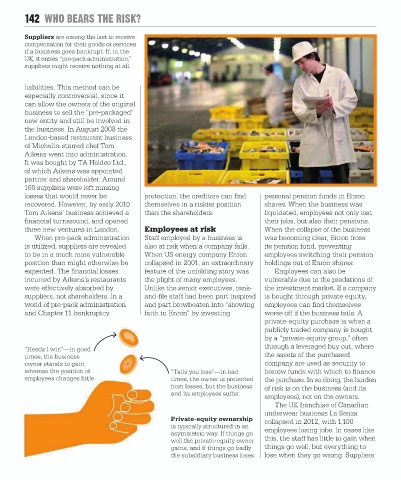
                                                asymmetric way. If things go    employees losing jobs. In cases like
                                                well the private-equity owner   this, the staff has little to gain when
                                                gains, and if things go badly    things go well, but everything to
                                                the subsidiary business loses.  lose when they go wrong. Suppliers

