


Page 146 - (DK) The Business Book
P. 146
144 WHO BEARS THE RISK?


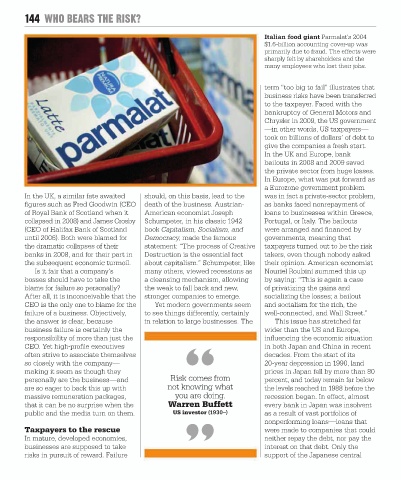
                                                                          Italian food giant Parmalat’s 2004
                                                                          $1.6-billion accounting cover-up was
                                                                          primarily due to fraud. The effects were
                                                                          sharply felt by shareholders and the
                                                                          many employees who lost their jobs.


                                                                          term “too big to fail” illustrates that
                                                                          business risks have been transferred
                                                                          to the taxpayer. Faced with the
                                                                          bankruptcy of General Motors and
                                                                          Chrysler in 2009, the US government
                                                                          —in other words, US taxpayers—
                                                                          took on billions of dollars’ of debt to
                                                                          give the companies a fresh start.
                                                                          In the UK and Europe, bank
                                                                          bailouts in 2008 and 2009 saved
                                                                          the private sector from huge losses.
                                                                          In Europe, what was put forward as
                                                                          a Eurozone government problem
        In the UK, a similar fate awaited   should, on this basis, lead to the   was in fact a private-sector problem,
        figures such as Fred Goodwin (CEO  death of the business. Austrian-  as banks faced nonrepayment of
        of Royal Bank of Scotland when it   American economist Joseph     loans to businesses within Greece,
        collapsed in 2008) and James Crosby  Schumpeter, in his classic 1942   Portugal, or Italy. The bailouts
        (CEO of Halifax Bank of Scotland   book Capitalism, Socialism, and   were arranged and financed by
        until 2006). Both were blamed for   Democracy, made the famous    governments, meaning that
        the dramatic collapses of their   statement: “The process of Creative   taxpayers turned out to be the risk
        banks in 2008, and for their part in   Destruction is the essential fact   takers, even though nobody asked
        the subsequent economic turmoil.  about capitalism.” Schumpeter, like   their opinion. American economist
           Is it fair that a company’s   many others, viewed recessions as   Nouriel Roubini summed this up
        bosses should have to take the   a cleansing mechanism, allowing   by saying: “This is again a case
        blame for failure so personally?   the weak to fall back and new,   of privatizing the gains and
        After all, it is inconceivable that the  stronger companies to emerge.   socializing the losses; a bailout
        CEO is the only one to blame for the   Yet modern governments seem   and socialism for the rich, the
        failure of a business. Objectively,   to see things differently, certainly   well-connected, and Wall Street.”
        the answer is clear, because     in relation to large businesses. The   This issue has stretched far
        business failure is certainly the                                 wider than the US and Europe,
        responsibility of more than just the                              influencing the economic situation
        CEO. Yet high-profile executives                                   in both Japan and China in recent
        often strive to associate themselves                              decades. From the start of its
        so closely with the company—                                      20-year depression in 1990, land
        making it seem as though they                                     prices in Japan fell by more than 80
        personally are the business—and         Risk comes from           percent, and today remain far below
        are so eager to back this up with      not knowing what           the levels reached in 1988 before the
        massive remuneration packages,           you are doing.           recession began. In effect, almost
        that it can be no surprise when the    Warren Buffett             every bank in Japan was insolvent
        public and the media turn on them.       US investor (1930–)      as a result of vast portfolios of
                                                                          nonperforming loans—loans that
        Taxpayers to the rescue                                           were made to companies that could
        In mature, developed economies,                                   neither repay the debt, nor pay the
        businesses are supposed to take                                   interest on that debt. Only the
        risks in pursuit of reward. Failure                               support of the Japanese central

