


Page 25 - (DK) The Business Book
P. 25
START SMALL, THINK BIG          23

        See also: Stand out in the market 28–31   ■  Gaining an edge 32–39   ■  Reinventing and adapting 52–57   ■  Porter’s generic
        strategies 178–83   ■  Good and bad strategy 184–85   ■  The value chain 216–17   ■  Marketing mix 280–83


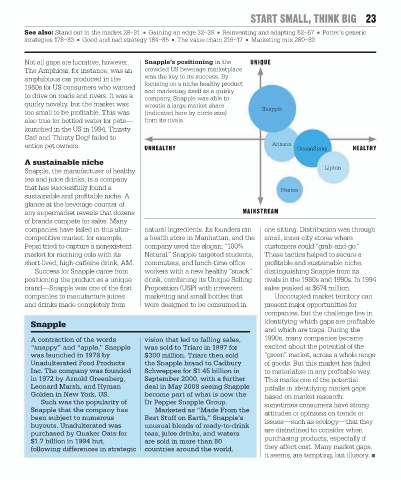
        Not all gaps are lucrative, however.   Snapple’s positioning in the   UNIQUE
        The Amphicar, for instance, was an   crowded US beverage marketplace
        amphibious car produced in the   was the key to its success. By
                                         focusing on a niche healthy product
        1960s for US consumers who wanted
                                         and marketing itself as a quirky
        to drive on roads and rivers. It was a   company, Snapple was able to
        quirky novelty, but the market was   wrestle a large market share   Snapple
        too small to be profitable. This was   (indicated here by circle size)
        also true for bottled water for pets—  from its rivals.
        launched in the US in 1994, Thirsty
        Cat! and Thirsty Dog! failed to
        entice pet owners.               UNHEALTHY                          Arizona  OceanSpray   HEALTHY
        A sustainable niche
                                                                                           Lipton
        Snapple, the manufacturer of healthy
        tea and juice drinks, is a company
        that has successfully found a
                                                                              Nestea
        sustainable and profitable niche. A
        glance at the beverage counter of
        any supermarket reveals that dozens                         MAINSTREAM
        of brands compete for sales. Many
        companies have failed in this ultra-  natural ingredients. Its founders ran   one sitting. Distribution was through
        competitive market: for example,   a health store in Manhattan, and the   small, inner-city stores where
        Pepsi tried to capture a nonexistent   company used the slogan: “100%   customers could “grab-and-go.”
        market for morning cola with its   Natural.” Snapple targeted students,   These tactics helped to secure a
        short-lived, high-caffeine drink, AM.  commuters, and lunch-time office   profitable and sustainable niche,
           Success for Snapple came from   workers with a new healthy “snack”   distinguishing Snapple from its
        positioning the product as a unique   drink, combining its Unique Selling   rivals in the 1980s and 1990s. In 1994
        brand—Snapple was one of the first   Proposition (USP) with irreverent   sales peaked at $674 million.
        companies to manufacture juices   marketing and small bottles that   Unoccupied market territory can
        and drinks made completely from   were designed to be consumed in   present major opportunities for
                                                                          companies, but the challenge lies in
          Snapple                                                         identifying which gaps are profitable
                                                                          and which are traps. During the
          A contraction of the words     vision that led to falling sales,   1990s, many companies became
          “snappy” and “apple,” Snapple   was sold to Triarc in 1997 for   excited about the potential of the
          was launched in 1978 by        $300 million. Triarc then sold   “green” market, across a whole range
          Unadulterated Food Products    the Snapple brand to Cadbury     of goods. But this market has failed
          Inc. The company was founded   Schweppes for $1.45 billion in   to materialize in any profitable way.
          in 1972 by Arnold Greenberg,   September 2000, with a further   This marks one of the potential
          Leonard Marsh, and Hyman       deal in May 2008 seeing Snapple   pitfalls in identifying market gaps
          Golden in New York, US.        become part of what is now the   based on market research:
            Such was the popularity of   Dr Pepper Snapple Group.
                                                                          sometimes consumers have strong
          Snapple that the company has      Marketed as “Made From the
                                                                          attitudes or opinions on trends or
          been subject to numerous       Best Stuff on Earth,” Snapple’s   issues—such as ecology—that they
          buyouts. Unadulterated was     unusual blends of ready-to-drink
          purchased by Quaker Oats for   teas, juice drinks, and waters   are disinclined to consider when
                                                                          purchasing products, especially if
          $1.7 billion in 1994 but,      are sold in more than 80
                                                                          they affect cost. Many market gaps,
          following differences in strategic  countries around the world.
                                                                          it seems, are tempting, but illusory. ■

