


Page 106 - (DK Eyewitness) Travel Guide - Vienna
P. 106
104 VIENNA AREA B Y AREA HOFBURG QU AR TER 105
Sachsen- Antonio Canova, and the tombs restored by Franz Anton Minoritenkirche was restored
Teschen, after of Maria Christina, favourite Maulbertsch (1769). The fine to its original Gothic style,
whom the daughter of Maria Theresa, and statues, including the likeness of when Maria Theresa’s son,
gallery is Leopold II. Both tombs are Karl VI in the hall, are the work Joseph II (see p30), made a gift
named. Today empty; the royal remains lie of Paul Strudel (1648–1708) and of the church to Vienna’s Italian
the Albertina in the Kaisergruft (see p106). his brother Peter (1660–1714). community. The church retains
houses a The church is also celebrated a fine west portal (1340) with
collection of for its music, including Masses statues beneath traceried
one million by Schubert or Haydn held g Burgkapelle canopies; the carvings above
prints, over here on Sundays. Hofburg, Schweizerhof. Map 4 D1 & the doorway are modern.
65,000 water- 5 B4. Tel 5339927. % Herrengasse. The interior of the church
colours and Open 10am–2pm Mon & Tue, 11am– is unexpectedly bright and
drawings, and f Prunksaal 1pm Fri. Closed Public holidays. & 8 large and contains a mosaic
some 70,000 Josefsplatz 1. Map 4 D1 & 5 C4. ^ Vienna Boys’ Choir:Jan–Jun & Sep– copy of Leonardo da Vinci’s
Greenhouses in the Burggarten by Friedrich Ohmann (1858–1927) photographs. Tel 53410394. % Herrengasse. Dec: 9:15am Sun (book via website). Last Supper. Napoleon
Highlights @ 1A, 2A. Open 10am–6pm Tue– & ∑ hofmusikkapelle.gv.at Bonaparte commissioned
a Burggarten include works by Dürer, with Sun, 10am–9pm Thu. & 8 9 7 Giacomo Raffaelli to execute
Michelangelo and Rubens also ∑ onb.ac.at From the Schweizerhof, steps this work as he proposed to
Burgring/Opernring. Map 4 D1 & 5 B4.
% Karlsplatz. v D, 1, 2, 71. Open well represented. Picasso heads lead up to the Burgkapelle, or substitute it for the original
Apr–Oct: 6am–10pm daily; Nov–Mar: a fine 20th-century section. Commissioned as the court Hofburg Chapel, originally No. 4 Minoritenplatz in Milan and remove the real
6:30am–7pm daily. Temporary exhibitions feature library by Karl VI, the State Hall, constructed in 1296 but painting to Paris. Following
paintings on loan along with or Prunksaal, of the National modified 150 years later. On l Minoritenplatz Napoleon’s downfall at
Before leaving Vienna, Napoleon works owned by the Albertina. Library was designed by Johann Sundays, visitors can hear the Map 2 D5 & 5 B3. % Herrengasse. Waterloo in 1815, Raffaelli’s
showed his contempt for the The Batliner Collection, which Bernhard Fischer von Erlach Wiener Sängerknaben, the version was bought by the
Viennese by razing part of the comprises over 500 works of art (see p149) in 1719. After his Vienna Boys’ Choir (see p41). At No. 1 Minoritenplatz is the Habsburgs. In the south aisle
city walls that had proved so and is one of the most significant death in 1723, the building The chapel interior has Gothic Baroque-style State Archives is a painted statue of the
ineffective at preventing his private collections in Europe, was completed by his son. The carvings and statuary in building (the archives are no Madonna and Child (dating
entry. Some of the space left is on permanent loan. collection consists of approx- canopied niches, and boasts longer housed here), built from around 1350), while at
around the Hofburg was later The extension on the Burg- imately 2.6 million books and a bronze crucifix (1720) by onto the back of the Bunders- the same spot in the north
transformed by the Habsburgs garten side houses study includes the personal library of Johann Känischbauer. kanzleramt in 1902. There are aisle is a faded frag ment of
into a landscaped garden, facilities and the largest of Prince Eugene (see pp28–9), as a number of palaces around a 16th-century fresco
planted with a variety of trees. the three exhibition halls. well as books that were taken h Spanish Riding the square. No. 3 is the former of St Francis of Assisi.
It was opened to the public Renovation has restored a from mon astic libraries closed Dietrichstein Palace of 1755,
in 1918. number of features of the during the religious reforms of School an early building by Franz
Overlooking the garden are Albertina to their former glory, Joseph II (see pp30–31). See pp100–101. Hillebrand. It now contains
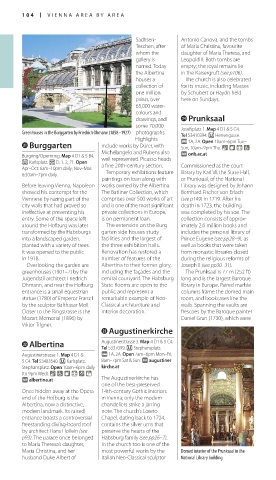
greenhouses (1901–7) by the including the façades and the The Prunksaal is 77 m (252 ft) the offices of the Federal
Jugendstil architect Friedrich central courtyard. The Habsburg long and is the largest Baroque Chancellor and the Foreign
Ohmann, and near the Hofburg State Rooms are open to the library in Europe. Paired marble j State Apartments Office. No. 4 is the side of the
entrance is a small equestrian public and represent a columns frame the domed main and Treasury Liechtenstein Palace on
statue (1780) of Emperor Franz I remarkable example of Neo- room, and bookcases line the Bankgasse (see p106). The mid-
by the sculptor Balthasar Moll. Classical architecture and walls. Spanning the vaults are See pp102–3. 17th-century Starhemberg
Closer to the Ringstrasse is the interior decoration. frescoes by the Baroque painter Palace is at No. 5. Now housing
Mozart Memorial (1896) by Daniel Gran (1730), which were ministry offices, it was the
Viktor Tilgner. k Bundeskanzleramt residence of Count Ernst
d Augustinerkirche Rüdiger von Starhemberg, a
Ballhausplatz 2. Map 1 C5 & 5 B3. hero of the 1683 Turkish siege
s Albertina Augustinerstrasse 3. Map 4 D1 & 5 C4. Tel 531150. % Herrengasse. @ 1A, (see p29), when he led the
Tel 5337099. % Stephansplatz. 2A. Closed to the public.
Augustinerstrasse 1. Map 4 D1 & @ 1A, 2A. Open 7am–6pm Mon–Fri, The Bundeskanzleramt (1717– Austrian forces within the city.
5 C4. Tel 53483540. % Karlsplatz, 8am–7pm Sat & Sun. ∑ augustiner
Stephansplatz. Open 10am–6pm daily kirche.at 19), the Austrian Chancery z Minoritenkirche
(to 9pm Wed). & 7 8 9 0 = and Foreign Ministry, was
∑ albertina.at The Augustinerkirche has designed by Johann Lukas von Minoritenplatz 2. Map 1 C5 & 5 B3.
one of the best-preserved Hildebrandt (see p154) and was Tel 676 6264113. % Herrengasse.
Once hidden away at the Opera 14th-century Gothic interiors expanded to its present size in Open 9am–6pm daily.
end of the Hofburg is the in Vienna; only the modern 1766 by Nikolaus Pacassi. Major
Albertina, now a distinctive, chandeliers strike a jarring events that shaped Austria’s This ancient church was
modern landmark. Its raised note. The church’s Loreto history have taken place here, established here by the Minor
entrance boasts a controversial Chapel, dating back to 1724, including meetings of the friars in around 1224, although
freestan ding diving-board roof contains the silver urns that Congress of Vienna (see p32) in the present structure dates
by architect Hans Hollein (see preserve the hearts of the 1814–15, the final delib erations from 1339. The tower was
p93). The palace once belonged Habsburg family (see pp26–7). in 1914 that led to the outbreak given its odd pyramidal shape
to Maria Theresa’s daughter, In the church too is one of the of World War I, and the murder during the Turkish siege of 1529,
Maria Christina, and her most powerful works by the Domed interior of the Prunksaal in the of Chancellor Dollfuss by Nazi when shells sliced the top off Gothic statue (c. 1400) of Leopold III in the
husband Duke Albert of Italian Neo-Classical sculptor National Library building terrorists in 1934 (see p38). the steeple. In the 1780s the Burgkapelle
104-105_EW_Vienna.indd 104 03/10/17 11:00 am 104-105_EW_Vienna.indd 105 03/10/17 11:00 am
Eyewitness Travel LAYERS PRINTED:
Catalogue template “UK” LAYER
(Source v2.4)
Date 25th April 2013
Size 125mm x 217mm

