


Page 102 - (DK Eyewitness) Travel Guide - Vienna
P. 102
100 VIENNA AREA B Y AREA
h Spanish Riding School
The origins of the Spanish Riding School are obscure, but it is
believed to have been founded in 1572 to cultivate the classic
skills of haute école horsemanship. By breeding and training
horses from Spain, the Habsburgs formed the Spanische
Reitschule. Today, 80-minute shows take place in the building
known as the Winter Riding School. Commissioned by Karl VI, it
was built between 1729 and 1735 to a design by Josef Emanuel
Fischer von Erlach. There are two entrances to the building –
one from Josefsplatz, the other from the Michaelerkuppel.
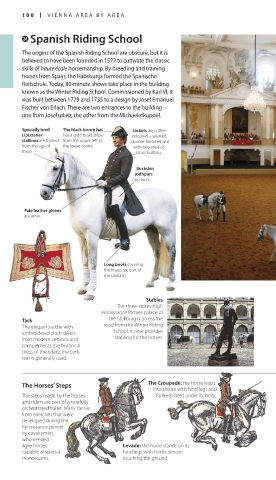
Specially bred The black bicorn hat Jackets are coffee-
Lipizzaner has a gold braid stripe coloured – waisted,
stallions are trained from the upper left to double-breasted and
from the age of the lower centre. with two rows of
three. brass buttons.
Buckskin
jodhpurs
are worn.
Pale leather gloves
are worn.
Long boots covering
the knees are part of
the uniform.
Stables
The three-storey-high
Renaissance former palace of
Tack the Stallburg is across the
The elegant saddle with road from the Winter Riding
embroidered cloth differs School. It now provides
from modern versions and stabling for the horses.
complements the historical
dress of the riders; the curb
rein is generally used.
The Horses’ Steps The Croupade: the horse leaps
into the air with hind legs and
The steps made by the horses forelegs bent under its belly.
and riders are part of a carefully
orchestrated ballet. Many derive
from exercises that were
developed during the
Renaissance period
by cavalrymen,
who needed
agile horses Levade: the horse stands on its
capable of special hind legs with hocks almost
manoeuvres. touching the ground.
100-101_EW_Vienna.indd 100 03/10/17 11:12 am

