


Page 168 - (DK Eyewitness) Travel Guide - Vienna
P. 168
166 VIENNA AREA B Y AREA FUR THER AFIELD 167
through to the 20th century, as Bruckner among others – is the the construction of other
well as the various methods of single most photographed installations around Vienna
capital punishment used on memorial in Vienna: Edmund meant that the operations of
some of them. The museum Heller’s “golden” (actually gilded the complex had to be scaled
also examines the development bronze) statue of Johann down, and of the seven original
of the police force and its Strauss playing a violin. English buildings only the highly
approach to tackling crime. park design was the inspiration. decorative yellow- and red-brick
Many of the exhibits come There is a large playground for water tower, with its ornate
from the archives of the children featuring swings, slides, turrets and pinnacles, remains.
Viennese police force and are climbing frames, a sand pit The restored interior, in contrast
distinctly gruesome; there is and a skate park. The Italian with the attractive exterior,
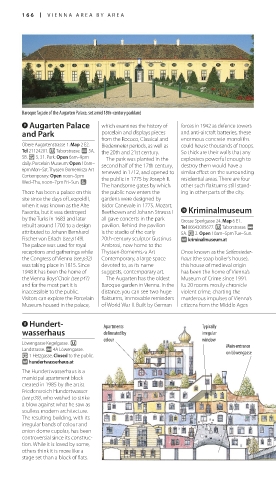
Baroque façade of the Augarten Palace, set amid 18th-century parkland a wide selection of murder Renaissance-style Kursalon has comprises a vast steel structure,
weapons, mummified heads of summer open-air concerts and ready to store and pump water.
9 Augarten Palace which examines the history of forces in 1942 as defence towers executed criminals, death masks costume balls. The restaurant is Guided tours are available to the
and Park porcelain and displays pieces and anti-aircraft batteries, these and case histories illustrated with a popular meeting place. public and visitors who make
from the Rococo, Classical and enormous concrete monoliths photographs and prints. Political the climb up the spiral staircase
Obere Augartenstrasse 1. Map 2 E2. Biedermeier periods, as well as could house thou sands of troops. criminality, from failed coup are rewarded with impressive
Tel 21124201. % Taborstrasse. @ 5A, the 20th and 21st century. So thick are their walls that any attempts to the rather more r Heeresgeschicht views of the city, including the
5B. v 5, 31. Park: Open 6am–9pm The park was planted in the explosives powerful enough to grisly lynching of a government liches Museum nearby Prater funfair, which is
daily. Porcelain Museum: Open 10am– second half of the 17th century, destroy them would have a minister during the revolution of pinpointed by its striking Ferris
6pm Mon–Sat. Thyssen-Bornemisza Art renewed in 1712, and opened to similar effect on the surrounding 1848 (see p32), is well covered. See pp168–9. wheel (see p234).
Contemporary: Open noon–5pm residential areas. There are four
Wed–Thu, noon–7pm Fri–Sun. 7 the public in 1775 by Joseph II. Though not for the faint-
The handsome gates by which other such flakturms still stand- hearted, the museum provides t Central Cemetery
There has been a palace on this the public now enters the ing in other parts of the city. visitors with a unique take on
site since the days of Leopold I, gardens were designed by Vienna’s social history. See pp170–71.
when it was known as the Alte Isidor Canevale in 1775. Mozart,
Favorita, but it was destroyed Beethoven and Johann Strauss I 0 Kriminalmuseum y Favoriten Water
by the Turks in 1683 and later all gave concerts in the park Grosse Sperlgasse 24. Map 6 E1. w Prater
rebuilt around 1700 to a design pavilion. Behind the pavilion Tel 06643005677. % Taborstrasse. @ See pp164–5. Tower
attributed to Johann Bernhard is the studio of the early 5A. v 2. Open 10am–5pm Tue–Sun. Windtenstrasse 3, Favoriten.
Fischer von Erlach (see p149). 20th-century sculptor Gustinus ∑ kriminalmuseum.at Tel 5995931070. % Reumannplatz.
The palace was used for royal Ambrosi, now home to the e Stadtpark @ 15A, 65A. v 1. Open for guided
receptions and gatherings while Thyssen-Bornemisza Art Once known as the Seifensieder Parkring. Map 6 E4. Tel 40008042. tours (phone to arrange).
the Congress of Vienna (see p32) Contemporary, a large space haus (the soap boiler’s house), % Stadtpark, Stubentor. @ 74A.
was taking place in 1815. Since devoted to, as its name this house of medieval origin v 2. Open 24 hours. The Favoriten pumping station
1948 it has been the home of suggests, contemporary art. has been the home of Vienna’s was constructed in 1889 by
the Vienna Boys’ Choir (see p41) The Augarten has the oldest Museum of Crime since 1991. Stadtpark, Vienna’s first and Franz Borkowitz as part of a
and for the most part it is Baroque garden in Vienna. In the Its 20 rooms mostly chronicle largest public park, opened municipal scheme for the
inaccessible to the public. distance, you can see two huge violent crime, charting the when the old city walls were transportation of drinking water
Visitors can explore the Porcelain flakturms, immovable reminders murderous impulses of Vienna’s demolished. Among many from the Alpine foothills to the
Museum housed in the palace, of World War II. Built by German citizens from the Middle Ages monuments – to Schubert and rapidly growing city. By 1910 Favoriten Water Tower
q Hundert- Apartments Typically Corner of block Roof gardens planted
wasserhaus delineated by irregular with first-floor with hundreds of trees
colour window café and staircase and shrubs
Löwengasse Kegelgasse. % Main entrance topped by
Landstrasse. @ 4A Löwengasse. onion dome
v 1 Hetzgasse. Closed to the public. on Löwengasse
∑ hundertwasserhaus.at
The Hundertwasserhaus is a
municipal apartment block Uneven
created in 1985 by the artist ceramic line
Friedensreich Hundertwasser
(see p39), who wished to strike
a blow against what he saw as
soulless modern architecture.
The resulting building, with its
irregular bands of colour and
onion dome cupolas, has been
controversial since its construc-
tion. While it is loved by some,
others think it is more like a
stage set than a block of flats.
166-167_EW_Vienna.indd 166 03/10/17 11:13 am 166-167_EW_Vienna.indd 167 03/10/17 11:13 am

