


Page 121 - (DK Eyewitness) Travel Guide - Estonia Latvia & Lithuania
P. 121
EASTERN EST ONIA 119
E KGB Cells Museum VISITORS’ CHECKLIST
Riia 15b. Tel 746 1717.
Open 11am–5pm Tue–Sat. & 8 Practical Information
∑ linnamuuseum.tartu.ee Road Map E2. * 100,000.
In the basement of the regional n Raekoja plats 9, 744 2111. _
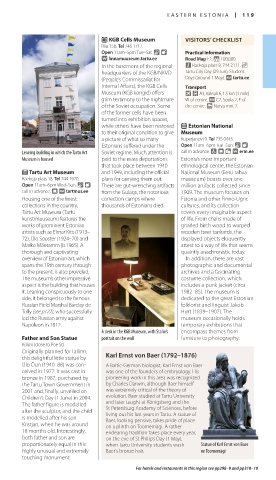
headquarters of the KGB/NKVD Tartu City Day (29 Jun), Student
(People’s Commissariat for Days (around 1 May). ∑ tartu.ee
Internal Affairs), the KGB Cells Transport
Museum (KGB kongid) offers k £ A3, Vaksali 6, 1.5 km (1 mile)
grim testimony to the nightmare W of centre. @ C2, Soola 2, E of
of the Soviet occupation. Some the centre. 4 Narva mnt 2.
of the former cells have been
turned into exhibition spaces,
while others have been restored E Estonian National
to their original condition to give Museum
a picture of what so many Kuperjanovi 9. Tel 735 0445.
Estonians suffered under the Open 11am–6pm Tue–Sun. & 8
Leaning building in which the Tartu Art Soviet regime. Much attention is call in advance. 7 - = ∑ erm.ee
Museum is housed paid to the mass deportations Estonia’s most important
that took place between 1940 ethnological centre, the Estonian
E Tartu Art Museum and 1949, including the official National Museum (Eesti rahva
Raekoja plats 18. Tel 744 1920. plans for carrying them out. muuseum) boasts over one
Open 11am–6pm Wed–Sun. & 8 There are gut-wrenching artifacts million artifacts col lected since
call in advance. - ∑ tartmus.ee from the Gulags, the notorious 1909. The museum focuses on
Housing one of the finest correction camps where Estonia and other Finno-Ugric
collections in the country, thou sands of Estonians died. cultures, and its collection
Tartu Art Museum (Tartu covers every imaginable aspect
kunstimuuseum) features the of life. From chairs made of
works of prominent Estonian gnarled birch wood to warped
artists such as Elmar Kits (1913– wooden beer tankards, the
72), Ülo Sooster (1924–70) and displayed objects eloquently
Marko Mäetamm (b.1965). A attest to a way of life that seems
thorough and cap tivating quaintly anachronistic today.
overview of Estonian art, which In addition, there are vast
spans the 19th cent ury through photographic and documental
to the present, is also provided. archives and a fascinating
The museum’s other impressive costume collection, which
aspect is the building that houses includes a punk jacket (circa
it. Leaning conspicuously to one 1982–85). The museum is
side, it belonged to the famous dedicated to the great Estonian
Russian Field Marshal Barclay de folklorist and linguist Jakob
Tolly (see p122), who suc cessfully Hurt (1839–1907). The
led the Russian army against museum occasionally holds
Napoleon in 1812. temporary exhibitions that
A desk in the KGB Museum, with Stalin’s encompass themes from
Father and Son Statue portrait on the wall furniture to photography.
Küüni (close to Poe St).
Originally planned for Tallinn,
this delightful little statue by Karl Ernst von Baer (1792–1876)
Ülo Õun (1940–88) was con- A Baltic-German biologist, Karl Ernst von Baer
ceived in 1977. It was cast in was one of the founders of embryo logy. His
bronze in 1987, purchased by pioneering work in this area was recognized
the Tartu Town Government in by Charles Darwin, although Baer himself
2001 and, finally, unveiled on was extremely critical of the theory of
Children’s Day (1 June) in 2004. evolution. Baer studied at Tartu University
The father figure is modelled and later taught at Königsberg and the
St Petersburg Academy of Sciences, before
after the sculptor, and the child living out his last years in Tartu. A statue of
is modelled after his son Baer, looking pensive, takes pride of place
Kristjan, when he was around on a plinth on Toomemägi. A rather
18 months old. Interestingly, endearing tradition takes place every year,
both father and son are on the eve of St Philip’s Day (1 May),
propor tionately equal in this when Tartu University students wash Statue of Karl Ernst von Baer
highly unusual and extremely Baer’s bronze hair. on Toomemägi
touching monument.
For hotels and restaurants in this region see pp298–9 and pp318–19
118-119_Tar.indd 119 15/02/17 10:14 am

