


Page 212 - (DK Eyewitness) Travel Guide - Estonia Latvia & Lithuania
P. 212
210 INTRODUCING LITHU ANIA
Despite its pagan past, Lithuania has
a strong Catholic identity that sets it
apart from Estonia and Latvia, where
the Germans introduced Lutheranism.
The efforts of the Soviet authorities to
stamp out religious worship by
converting churches into warehouses,
cinemas, art galleries and museums,
destroying their interiors and depor ting
large numbers of priests to Siberia,
failed. As a result, only 10 per cent
of the people do not identify with any
religious group today. Religious groups
other than Catholics include Russian
Catholics worshipping the Virgin Mary in Vilnius Orthodox (5 per cent) and small
communities of Old Believers
Ethnic and Religious Identity and Lutherans.
Lithuania is the most ethnically
homogeneous of the Baltic countries. Politics
By staying largely agrarian it managed to Since regaining independence in 1991,
stem the incoming tide of large numbers Lithuania has vacillated between left-
of Russians and other nation alities whom and right-wing governments, while
the Soviet authorities wanted to man the struggling to find its feet on the
new factories being built across the Baltic international stage. Achieving the
region. Of its population of 3 million, goals of NATO and EU membership in
84 per cent are Lithuanian, while only 2004 was of huge significance for the
5.8 per cent are Russian and 6.6 per cent Baltic region, wrenching it away from
Polish. Other minorities include Russia’s influence. The impeach ment of
Belarusians and Ukrainians, as well as a President Rolandas Paksas for violating
small group of Tatars and Karaim. In Vilnius, the constitution, also in 2004, was the
the most ethnically diverse city, Russian climax of a wave of public scepticism in
and Polish can commonly be heard. politics. High-profile corruption cases
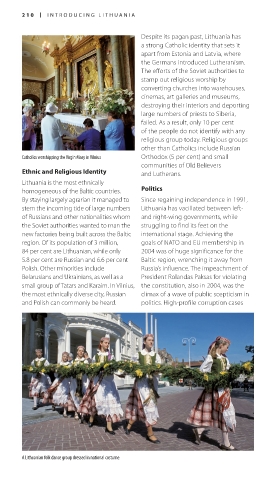
A Lithuanian folk dance group dressed in national costume
208-211.indd 210 15/02/17 10:20 am

