


Page 221 - (DK Eyewitness) Travel Guide - Estonia Latvia & Lithuania
P. 221
THE HIST OR Y OF LITHU ANIA 219
The Republic of Lithuania
In 1988, encouraged by the greater
openness of Soviet premier Mikhail
Gorbachev’s reforms, a group of
intel lectuals founded the Sąjūdis
movement to rally popular support for the
demonstrations that had begun the previous
year. The response was immediate. Peaceful
protests increased and, on 11 March 1990,
Lithuania declared its independence, the
first of any of the Soviet republics to do so.
In January 1991, Soviet tanks and troops
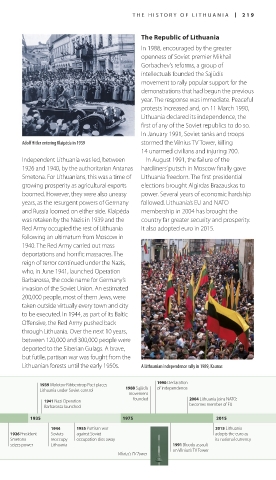
Adolf Hitler entering Klaipėda in 1939 stormed the Vilnius TV Tower, killing
14 unarmed civi lians and injuring 700.
Independent Lithuania was led, between In August 1991, the failure of the
1926 and 1940, by the authoritarian Antanas hardliners’ putsch in Moscow finally gave
Smetona. For Lithuanians, this was a time of Lithuania freedom. The first presidential
grow ing prosperity as agricultural exports elections brought Algirdas Brazauskas to
boomed. However, they were also uneasy power. Several years of economic hardship
years, as the resurgent powers of Germany followed. Lithuania’s EU and NATO
and Russia loomed on either side. Klaipėda membership in 2004 has brought the
was retaken by the Nazis in 1939 and the country far greater security and prosperity.
Red Army occu pied the rest of Lithuania It also adopted euro in 2015.
following an ultimatum from Moscow in
1940. The Red Army carried out mass
depor tations and horrific massacres. The
reign of terror continued under the Nazis,
who, in June 1941, launched Operation
Barbarossa, the code name for Germany’s
invasion of the Soviet Union. An estimated
200,000 people, most of them Jews, were
taken out side virtually every town and city
to be executed. In 1944, as part of its Baltic
Offensive, the Red Army pushed back
through Lithuania. Over the next 10 years,
between 120,000 and 300,000 people were
deported to the Siberian Gulags. A brave,
but futile, partisan war was fought from the
Lithuanian forests until the early 1950s. A Lithuanian independence rally in 1989, Kaunas
1990 Declaration
1939 Molotov-Ribbentrop Pact places
Lithuania under Soviet control 1988 Sąjūdis of independence
movement
founded 2004 Lithuania joins NATO;
1941 Nazi Operation
Barbarossa launched becomes member of EU
1935 1975 2015
1944 1955 Partisan war 2015 Lithuania
1926 President Soviets against Soviet adopts the euro as
Smetona reoccupy occupation dies away its national currency
seizes power Lithuania 1991 Bloody assault
on Vilnius’s TV Tower
Vilnius’s TV Tower
218-219_HistLth.indd 219 15/02/17 10:15 am

