


Page 281 - (DK Eyewitness) Travel Guide - Estonia Latvia & Lithuania
P. 281
WESTERN LITHU ANIA 279
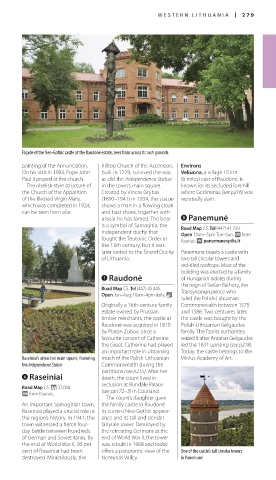
Façade of the Neo-Gothic castle at the Raudonė estate, seen from across its lush grounds
painting of the Annunciation. hilltop Church of the Ascension, Environs
On his visit in 1993, Pope John built in 1729, survived the war, Veliuona, a village 10 km
Paul II prayed at the church. as did the Independence Statue (6 miles) east of Raudonė, is
The obelisk-style structure of in the town’s main square. known for its secluded fort-hill
the Church of the Apparition Created by Vincas Grybas where Gediminas (see p216) was
of the Blessed Virgin Mary, (1890–1941) in 1934, the statue reputedly slain.
which was completed in 1924, shows a man in a flowing cloak
can be seen from afar. and bast shoes, together with
a bear he has tamed. The bear 8 Panemunė
is a symbol of Samogitia, the Road Map C5. Tel (447) 41 729.
independent duchy that Open 10am–5pm Tue–Sun. @ from
fought the Teutonic Order in Kaunas. ∑ panemunespilis.lt
the 13th century, but it was
later ceded to the Grand Duchy Panemunė boasts a castle with
of Lithuania. two tall circular towers and
red-tiled rooftops. Most of the
building was erected by a family
7 Raudonė of Hungarian nobles during
the reign of Stefan Bathory, the
Road Map C5. Tel (447) 45 445. Transylvanian prince who
Open Jun–Aug: 10am–4pm daily. &
ruled the Polish-Lithuanian
Originally a 16th-century family Commonwealth between 1575
estate owned by Prussian and 1586. Two centuries later,
timber merchants, the castle at the castle was bought by the
Raudonė was acquired in 1810 Polish-Lithuanian Gelgaudas
by Platon Zubov, once a family. The Tsarist authorities
favourite consort of Catherine seized it after Antanas Gelgaudas
the Great. Catherine had played led the 1831 uprising (see p218).
an important role in obtaining Today, the castle belongs to the
Raseiniai’s attractive main square, featuring much of the Polish-Lithuanian Vilnius Academy of Art.
the Independence Statue Commonwealth during the
partitions (see p215). After her
6 Raseiniai death, the count lived in
seclusion at Rundāle Palace
Road Map C5. * 37,000.
@ from Kaunas. (see pp172–3) in Courland.
The count’s daughter gave
An important Samogitian town, the family castle in Raudonė
Raseiniai played a crucial role in its current Neo-Gothic appear-
the region’s history. In 1941, the ance and its tall and slender
town witnessed a fierce four- fairytale tower. Destroyed by
day battle between hundreds the retreating Germans at the
of German and Soviet tanks. By end of World War II, the tower
the end of World War II, 90 per was rebuilt in 1968 and today
cent of Raseiniai had been offers a panoramic view of the One of the castle’s tall circular towers
destroyed. Miraculously, the Nemunas Valley. in Panemunė
278-279.indd 279 15/02/17 10:16 am

