


Page 219 - Vogue - India (January 2020)
P. 219
living


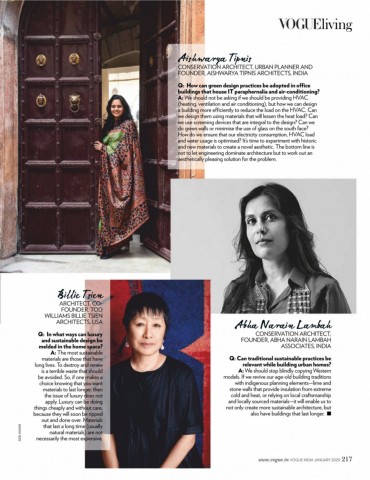
                                                                                Aishwarya Tipnis


                                                                                CONSERVATION ARCHITECT, URBAN PLANNER AND
                                                                                FOUNDER, AISHWARYA TIPNIS ARCHITECTS, INDIA


                                                                                Q:  How can green design practices be adopted in o   ce
                                                                                buildings that house IT paraphernalia and air-conditioning?
                                                                                A: We should not be asking if we should be providing HVAC
                                                                                (heating, ventilation and air conditioning), but how we can design
                                                                                a building more e   ciently to reduce the load on the HVAC. Can
                                                                                we design them using materials that will lessen the heat load? Can
                                                                                we use screening devices that are integral to the design? Can we
                                                                                do green walls or minimise the use of glass on the south face?
                                                                                How do we ensure that our electricity consumption, HVAC load
                                                                                and water usage is optimised? It’s time to experiment with historic
                                                                                and new materials to create a novel aesthetic. The bottom line is
                                                                                not to let engineering dominate architecture but to work out an
                                                                                aesthetically pleasing solution for the problem.


                          Billie Tsien


                           ARCHITECT, CO
                            FOUNDER, TOD
                     WILLIAMS BILLIE TSIEN
                          ARCHITECTS, USA                                                                 Abha Narain Lambah


                  Q:  In what ways can luxury                                                                      CONSERVATION ARCHITECT,
                   and sustainable design be                                                                FOUNDER, ABHA NARAIN LAMBAH
                  melded in the home space?                                                                                   ASSOCIATES, INDIA
                       A: The most sustainable
                   materials are those that have                                                       Q: Can traditional sustainable practices be
                long lives. To destroy and renew                                                             relevant while building urban homes?
                   is a terrible waste that should                                                         A: We should stop blindly copying Western
                  be avoided. So, if one makes a                                                     models. If we revive our age-old building traditions
                  choice knowing that you want                                                            with indigenous planning elements—lime and
                    materials to last longer, then                                                     stone walls that provide insulation from extreme
                     the issue of luxury does not                                                       cold and heat, or relying on local craftsmanship
                     apply. Luxury can be doing                                                        and locally sourced materials—it will enable us to
                things cheaply and without care,                                                      not only create more sustainable architecture, but
                because they will soon be ripped                                                                 also have buildings that last longer.  ■
                   out and done over. Materials
                    that last a long time (usually
          ADIL HASAN  necessarily the most expensive.
                       natural materials) are not


                                                                                                                    www.vogue.in VOGUE INDIA JANUARY       217

