


Page 38 - All About History - Issue 26-15
P. 38
SIEGEENGINES


        Sieges began in the ancient world as a way of
        breaching castles. As fortifications improved, so

        did the machines used to bring them down


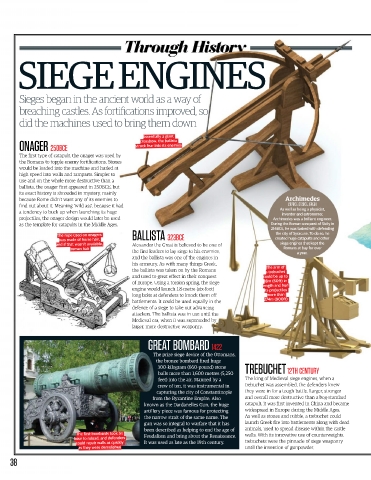
                                                   Essentially a giant
                                                  crossbow, the ballista
        ONAGER  250BCE                           struck fear into its enemies
        The first type of catapult, the onager was used by
        the Romans to topple enemy fortifications. Stones
        would be loaded into the machine and hurled at
        high speed into walls and ramparts. Simpler to
        use and on the whole more destructive than a
        ballista, the onager first appeared in 250BCE, but
        its exact history is shrouded in mystery, mainly
        because Rome didn’t want any of its enemies to                                               Archimedes
        find out about it. Meaning ‘wild ass’, because it had                                         287BCE-212BCE, GREEK
                                                                                                   As well as being a physicist,
        a tendency to buck up when launching its huge
                                                                                                    inventor and astronomer,
        projectiles, the onager design would later be used                                       Archimedes was a brilliant engineer.
        as the templateforcatapultsintheMiddleAges.                                             During the Roman conquest of Sicily in
                                                                                                214BCE, he was tasked with defending
                     The rope used on onagers   BALLISTA  323BCE                                  the city of Syracuse. To do so, he
                      was made of horse hair,                                                     created huge catapults and other
                     and if that wasn’t available,   Alexander the Great is believed to b          siege engines that kept the
                          human hair                                                                 Romans at bay for over
                                               the first leaders to lay siege to his en
                                                                                                         a year.
                                               and the ballista was one of the engi
                                               his armoury. As with many things G
                                                                                              The arm of
                                               the ballista was taken on by the Rom           a trebuchet
                                               and used to great effect in their con         could be up to
                                               of Europe. Using a torsion spring, th          18m (60ft) in
                                                                                             length and hurl
                                               engine would launch 1.8-metre (six-f           its projectiles
                                               long bolts at defenders to knock the            more than
                                                                                              274m (900ft)
                                               battlements. It could be used equally
                                               defence of a siege to take out advan
                                               attackers. The ballista was in use un
                                               Medieval era, when it was supersede
                                               larger, more destructive weaponry.

                                                     GREAT BOMBARD  1422
                                                       The prize siege device of the Ottomans,
                                                        the bronze bombard fired huge
                                                        300-kilogram (660-pound) stone   TREBUCHET  12TH CENTURY
                                                         balls more than 1,600 metres (5,250
                                                         feet) into the air. Manned by a   The king of Medieval siege engines, when a
                                                        crew of ten, it was instrumental in   trebuchet was assembled, the defenders knew
                                                        capturing the city of Constantinople   they were in for a tough battle. Larger, stronger
                                                       from the Byzantine Empire. Also   and overall more destructive than a bog-standard
                                                    known as the Dardanelles Gun, the huge   catapult, it was first invented in China and became
                                                    artillery piece was famous for protecting   widespread in Europe during the Middle Ages.
                                                    the narrow strait of the same name. The   As well as stones and rubble, a trebuchet could
                                                    gun was so integral to warfare that it has   launch Greek fire into battlements along with dead
                                                    been described as helping to end the age of   animals, used to spread disease within the castle
                            The first bombards took an                                 walls. With its innovative use of counterweights,
                           hour to reload, and defenders   Feudalism and bring about the Renaissance.
                            could repair walls as quickly   It was used as late as the 19th century.   trebuchets were the pinnacle of siege weaponry
                             as they were demolished                                   until the invention of gunpowder.
     38

