


Page 39 - All About History - Issue 26-15
P. 39
Through History


                                                                  The very first rams were
                                                                    powered by human
                                                                   muscle, but a rope and
                                                                   pulley system was soon
                                                                                                    1
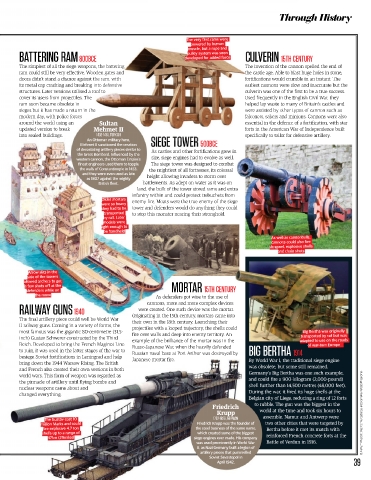
        BATTERING RAM  800BC                                      developed for added force  ULVERIN  5TH CENTURY
        The simplest of all the siege weapon                                           The invention of the cannon spelled the end of
        ram could still be very effective. Woo                                         the castle age. Able to blast huge holes in stone,
        doors didn’t stand a chance against t                                          fortifications would crumble in an instant. The
        its metal cap crashing and breaking                                            earliest cannons were slow and inaccurate but the
        structures. Later versions utilised a r                                        culverin was one of the first to be a true success.
        cover its users from projectiles. The                                          Used frequently in the English Civil War, they
        ram soon became obsolete in                                                    helped lay waste to many of Britain’s castles and
        sieges but it has made a return in the                                         were assisted by other types of cannon such as
        modern day, with police forces                                                 falconets, sakers and minions. Cannons were also
        around the world using an   Sultan                                             essential in the defence of a fortification, with star
        updated version to break  Mehmet II                                            forts in the American War of Independence built
        into sealed buildings.      1432-1481, TURKISH                                 specifically to tailor for defensive artillery.
                                An Ottoman military hero,
                             Mehmet II sanctioned the creation         500BCE
                            of devastating artillery pieces similar to   Ascastlesandotherfortificationsgrewin
                            the Great Bombard. Influenced by the
                            western cannon, the Ottoman Empire’s   size,siegeengineshadtoevolveaswell.
                             finest engineers used them to topple   The siege tower was designed to combat
                             the walls of Constantinople in 1453,   themightiestofallfortresses,itscolossal
                              and they were even used as late
                               as 1807 against the mighty   height allowing invaders to storm over
                                    British fleet.  battlements.Asadeptonwaterasitwason
                                                 land, the bulk of the tower stored rams and extra
                                               infantrywithinandcouldprotecttrebuchetsfrom
                                     Older mortars
                                     were so heavy   enemy fire. Moats were the true enemy of the siege
                                     they had to be   tower and defenders would do anything they could
                                      transported   to stop this monster nearing their stronghold.
                                     by rail. Later
                                     models were
                                     light enough to
                                     be handheld
                                                                                                As well as cannonballs,
                                                                                                cannons could also fire
                                                                                                shrapnel, explosive shells
                                                                                                   and chain shots


           Arrow slits in the
           side of the towers
         allowed archers to get
          a few shots off at the                             MORTAR  5TH CENTURY
                                                                         1
          defenders while on
             the move                                   As defenders got wise to the use of
                                                     cannons, more and more complex devices
        RAILWAY GUNS  1940                        were created. One such device was the mortar.
                                               Originating in the 15th century, mortars came into
        The final artillery piece could well be World War
                                               their own in the 18th century. Launching their
        II railway guns. Coming in a variety of forms, the
                                               projectiles with a looped trajectory, the shells could
        most famous was the gigantic 80-centimetre (31.5-                                                  Big Bertha was originally
                                               fire over walls and deep into enemy territory. An
        inch) Gustav Schwerer constructed by the Third                                                     transported by rail but was
                                               example of the brilliance of the mortar was in the         adapted to use on the roads
        Reich. Developed to bring the French Maginot Line                                                    of war-torn Europe
                                               Russo-Japanese War, when the heavily defended
        to ruin, it was used in the latter stages of the war to
                                               Russian naval base at Port Arthur was destroyed by   BIG BERTHA 1914
        besiege Soviet fortifications in Leningrad and help
                                               Japanese mortar fire                     By World War I, the traditional siege engine
        bring down the 1944 Warsaw Rising. The British
                                                                                        was obsolete, but some still remained.
        and French also created their own versions in both
                                                                                        Germany’s Big Bertha was one such example,
        world wars. This form of weapon was regarded as
                                                                                        and could fire a 900-kilogram (2,000-pound)
        the pinnacle of artillery until flying bombs and
                                                                                        shell further than 14,500 metres (48,000 feet).
        nuclear weapons came about and
                                                                                        During the war, it fired its huge shells at the
        changed everything.
                                                                                        Belgian city of Liege, reducing a ring of 12 forts
                                                                            Friedrich     to rubble. The gun was the biggest in the
                                                                             Krupp          world at the time and took six hours to   © Alamy, Thinkstock; Dreamstime; Csaba Gyulai (Codename: Panzers Phase One).
                 The Gustav cost 10                                         1787-1826, GERMAN  assemble. Namur and Antwerp were
               million Marks and could                                Friedrich Krupp was the founder of   two other cities that were targeted by
                fire explosive 4.7 ton                                the steel business of the same name,   Bertha before it met its match with
                shells up to a range of                               which created some of the biggest
                  47km (29miles)                                     siege engines ever made. His company   reinforced French concrete forts at the
                                                                      was used prominently in World War   Battle of Verdun in 1916.
                                                                      II, as Nazi Germany built a legion of
                                                                       artillery pieces that pummelled
                                                                           Soviet Sevastopol in
                                                                             April 1942.                                     39

