


Page 163 - (DK Eyewitness) Travel Guide - Portugal
P. 163
local arts, crafts and industries,
including the processing of salt ANIMALS OF THE
and cork over the centuries. SADO ESTUARY
The star-shaped Castelo A protected nature
de São Filipe was built in 1595 reserve, the Sado
by Philip II of Spain during the estuary is an area of
period of Spanish rule to keep salt marsh home to
a wary eye on pirates, English nesting storks and
invaders and the local popu- flamingos, and the only
lation. It now houses a place along the Portu
boutique hotel, but the guese coast where you
battlements and ramparts can see wild bottlenose
are open to the public and dolphins. Many water
offer marvellous views over birds, including avocets
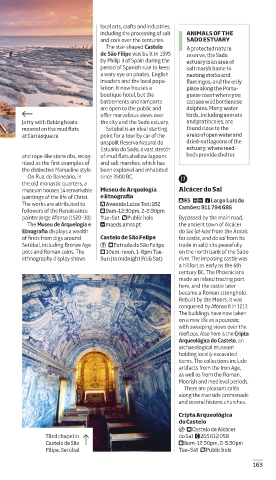
Jetty with fishing boats the city and the Sado estuary. and pratincoles, are
moored on the mud flats Setúbal is an ideal starting found close to the
at Carrasqueira point for a tour by car of the areas of open water and
unspoilt Reserva Natural do driedout lagoons of the
Estuário do Sado, a vast stretch estuary, where reed
and rope-like stone ribs, recog- of mud flats,shallow lagoons beds provide shelter.
nized as the first examples of and salt marshes, which has
the distinctive Manueline style. been explored and inhabited
On Rua do Balneário, in since 3500 BC. 17
the old monastic quarters, a
museum houses 14 remarkable Museu de Arquelogia Alcácer do Sal
paintings of the life of Christ. e Etnografia ! E5 £ @ n Largo Luís de
The works are attrib uted to ⌂ Avenida Luísa Todi 162 Camões; 911 794 685
followers of the Renaissance # 9am–12:30pm, 2–5:30pm
painter Jorge Afonso (1520–30). Tue–Sat ¢ Public hols Bypassed by the main road,
The Museu de Arquelogia e ∑ maeds.amrs.pt the ancient town of Alcácer
Etnografia displays a wealth do Sal (al-kasr from the Arabic
of finds from digs around Castelo de São Felipe for castle, and do sal from its
Setúbal, including Bronze Age \ ⌂ Estrada de São Felipe trade in salt) sits peacefully
pots and Roman coins. The # 10am–noon, 1–6pm Tue– on the north bank of the Sado
ethno graphy display shows Sun (to midnight Fri & Sat) river. The impos ing castle was
a hillfort as early as the 6th
century BC. The Phoenicians
made an inland trading port
here, and the castle later
became a Roman stronghold.
Rebuilt by the Moors, it was
conquered by Afonso II in 1217.
The buildings have now taken
on a new life as a pousada,
with sweeping views over the
rooft ops. Also here is the Cripta
Arqueológica do Castelo, an
archaeological museum
holding locally excavated
items. The collections include
artifacts from the Iron Age,
as well as from the Roman,
Moorish and medieval periods.
There are pleasant cafés
along the riverside promenade
and several historic churches.
Cripta Arqueológica
do Castelo
" ⌂ Castelo de Alcácer
Tiled chapel in do Sal § 265 612 058
Castelo de São # 9am–12:30pm, 2–5:30pm
Filipe, Setúbal Tue–Sat ¢ Public hols
163
162-163_EW_Portugal.indd 163 20/09/2018 10:40

