


Page 95 - (DK Eyewitness) Travel Guide - Portugal
P. 95
Must See
                               European Art
                            Top Collections  from the 14th to the 19th century, hang
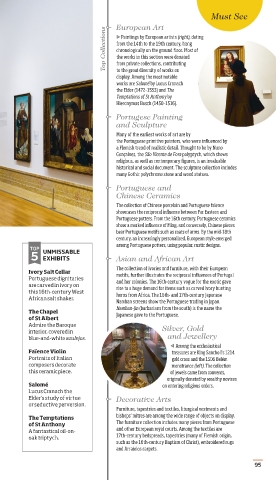
                                 ▶  Paintings by European artists (right), dating
                               chronologically on the ground floor. Most of
                               the works in this section were donated
                               from private collec tions, contributing
                               to the great diversity of works on
                               display. Among the most notable
                               works are Salomé by Lucus Cranach
                               the Elder (1472–1553) and The
                               Temptations of St Anthony by
                               Hieronymus Bosch (1450–1516).
                               Portugese Painting
                               and Sculpture
                               Many of the earliest works of art are by
                               the Portuguese primitive painters, who were influenced by
                               a Flemish trend of realistic detail. Thought to be by Nuno
                               Gonçalves, the São Vicente de Fora polyptych, which shows
                               religious, as well as contemporary figures, is an invaluable
                               historical and social document. The sculpture collection includes
                               many Gothic polychrome stone and wood statues.
                               Portuguese and
                               Chinese Ceramics
                               The collection of Chinese porcelain and Portuguese faïence
                               showcases the reciprocal influence between Far Eastern and
                               Portuguese potters. From the 16th century, Portuguese ceramics
                               show a marked influence of Ming, and conversely, Chinese pieces
                               bear Portuguese motifs such as coats of arms. By the mid-18th
                               century, an increasingly personalized, European style emerged
                               among Portuguese potters, using popular, rustic designs.
         TOP  UNMISSABLE
         5  EXHIBITS           Asian and African Art
                               The collection of ivories and furniture, with their European
        Ivory Salt Cellar      motifs, further illustrates the reciprocal influences of Portugal
        Portuguese dignitaries    and her colonies. The 16th-century vogue for the exotic gave
        are carved in ivory on   rise to a huge demand for items such as carved ivory hunting
        this 16th-century West   horns from Africa. The 16th- and 17th-century Japanese
        African salt shaker.
                               Namban screens show the Portuguese trading in Japan.
                               Namban-jin (barbarians from the south) is the name the
        The Chapel             Japanese gave to the Portuguese.
        of St Albert
        Admire the Baroque                 Silver, Gold
        interior, covered in
        blue-and-white azulejos.            and Jewellery
                                               ◀  Among the ecclesiastical
        Faïence Violin                       treasures are King Sancho I’s 1214
        Portraits of Italian                 gold cross and the 1506 Belém
        composers decorate                   monstrance (left). The collection
        this ceramic piece.                  of jewels came from convents,
                                            originally donated by wealthy novices
        Salomé                             on entering religious orders.
        Lucus Cranach the
        Elder’s study of virtue   Decorative Arts
        or seductive perversion.
                               Furniture, tapestries and textiles, liturgical vestments and
        The Temptations        bishops’ mitres are among the wide range of objects on display.
        of St Anthony          The furniture collection includes many pieces from Portuguese
        A fantastical oil-on-   and other European royal courts. Among the textiles are
        oak triptych.          17th-century bedspreads, tapestries (many of Flemish origin,
                               such as the 16th-century Baptism of Christ), embroidered rugs
                               and Arraiolos carpets.
                                                                  95


   094-095_EW_Portugal.indd   95                             20/09/2018   10:39

