


Page 73 - All About History - Issue 08-14
P. 73
HOOVER’S WAR ON CRIME


                                                       ORGANISED CRIME

                                                       Organised crime had become endemic in the
                                                                                        Hoover’s leadership. Dillinger was responsible for
                                                       United States during the Twenties and Thirties
                                                                                        numerous escapes from jail at a time when the
                                                      because of the prohibition laws on alcohol
                                                                                        FBI was saying they were closing in on him. The
                                                      that gave rise to criminal networks running
                                                                                        ‘shoot first and ask questions later’ approach also
                                                      speakeasies and racketeering throughout the
                                                                                        landed the Bureau in hot water, with accusations
                                                      country. The federal government could only offer
                                                                                        that Hoover’s agents were little more than
                                                      limited support in helping local law enforcement
                                                                                        trigger-happy government thugs.
                                                      because of the lack of national resources.
                                                                                         After the end of World War II the bootlegger
                                                      Hoover changed this by lobbying for more
                                                                                        age faded and crime families like the Costellos
                                                      funding into fighting federal crime through the
                                                                                        and Carmines began to take over the gambling
                                                      FBI. He went after some of the most notorious
                                                                                        and racketeering rings of major US cities.
                                                      criminal gangs in the country, in particular the
                                                                                       Hoover and the FBI set about shutting them
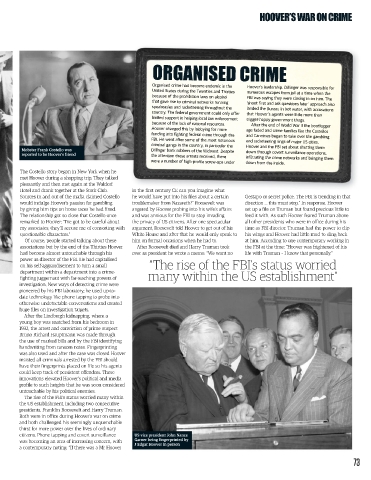
         Mobster Frank Costello was                   Dillinger bank robbers of the Midwest. Despite
         reported to be Hoover’s friend                                                down through covert surveillance operations,
                                                      the attention these arrests received, there
                                                                                       infiltrating the crime networks and bringing them
                                                      were a number of high-profile screw-ups under   down from the inside.
        The Costello story began in New York when he
        met Hoover during a shopping trip. They talked
        pleasantly and then met again at the Waldorf
        Hotel and drank together at the Stork Club.   in the first century CE can you imagine what

        Sources in and out of the mafia claimed Costello   he would have put into his files about a certain   Gestapo or secret police. The FBI is trending in that
        would indulge Hoover’s passion for gambling   troublemaker from Nazareth?” Roosevelt was   direction … this must stop.” In response, Hoover
        by giving him tips on horse races he had fixed.   angered by Hoover probing into his wife’s affairs   set up a file on Truman but found precious little to
        The relationship got so close that Costello once   and was anxious for the FBI to stop invading   feed it with. As such Hoover feared Truman above
        remarked to Hoover: “I’ve got to be careful about   the privacy of US citizens. After one spectacular   all other presidents who were in office during his
        my associates; they’ll accuse me of consorting with   argument, Roosevelt told Hoover to get out of his   time as FBI director. Truman had the power to clip
        questionable characters.”              White House and after that he would only speak to   his wings and Hoover had little mud to sling back
          Of course, people started talking about these   him on formal occasions when he had to.  at him. According to one contemporary working in
        associations but by the end of the Thirties Hoover   After Roosevelt died and Harry Truman took   the FBI at the time: “Hoover was frightened of his
        had become almost untouchable through his   over as president he wrote a memo: “We want no   life with Truman – I know that personally.”
        power as director of the FBI. He had capitalised
        on his self-aggrandisement to turn a small   “The rise of the FBI’s status worried
        department within a department into a crime-
        fighting juggernaut with far-reaching powers of   many within the US establishment”
        investigation. New ways of detecting crime were
        pioneered by his FBI laboratory; he used up-to-
        date technology like phone tapping to probe into
        otherwise undetectable conversations and created
        huge files on investigation targets.
          After the Lindbergh kidnapping, where a
        young boy was snatched from his bedroom in
        1932, the arrest and conviction of prime suspect
        Bruno Richard Hauptmann was made through
        the use of marked bills and by the FBI identifying
        handwriting from ransom notes. Fingerprinting
        was also used and after the case was closed Hoover
        insisted all criminals arrested by the FBI should
        have their fingerprints placed on file so his agents
        could keep track of persistent offenders. These
        innovations elevated Hoover’s political and media
        profile to such heights that he was soon considered
        untouchable by his political enemies.
          The rise of the FBI’s status worried many within
        the US establishment, including two consecutive
        presidents, Franklin Roosevelt and Harry Truman.
        Both were in office during Hoover’s war on crime
        and both challenged his seemingly unquenchable
        thirst for more power over the lives of ordinary
        citizens. Phone tapping and covert surveillance   US vice president John Nance
        was becoming an area of increasing concern, with   Garner being fingerprinted by
                                                J Edgar Hoover in person
        a contemporary noting: “If there was a Mr Hoover
                                                                                                                             73

