


Page 72 - All About History - Issue 08-14
P. 72
HOOVER’S WAR ON CRIME


        could claim the credit. It made front-page news
        in the newspapers and he smiled when he read
        America had found their new tough guy on crime.
         The Karpis arrest was stage-managed by
        Hoover and his assistant director Clyde Tolson to
        answer criticism from a Senate committee. They
        were concerned by Hoover’s demands for more
        powers for the FBI even though he had never
        served in the field or personally made an arrest.
        As with all criticism, Hoover took it personally
        – so personally he saw to it that he would be
        involved on the ground in the next big arrest.
        To do so he personally chartered a special flight
        down to New Orleans for him and 14 of his men
        on 24-hour notice, which in the Thirties was an
        astonishing feat and nearly impossible for most of
        the population.
         Not two years before he had overseen the arrest
        of the man they said could never be caught; John
        Dillinger. The criminal was becoming a folk legend
        in the Midwest, targeting greedy banks, which
        were seen to be the cause of the great depression.
        As far as Hoover was concerned he was a common
        criminal, ‘a beer-drinking plug-ugly’ that needed
        to be arrested. The FBI track record on trying to
        catch Dillinger was less than impressive, though. A
        high-profile screw-up in April 1934, where agents
        allowed Dillinger to escape from a hotel they had
        apparently surrounded, caused no end of bad press
        for Hoover and the FBI. Like his battles with the
        Senate two years later it had also become personal;
        Dillinger was taunting Hoover with postcards
        saying he’d never catch him.
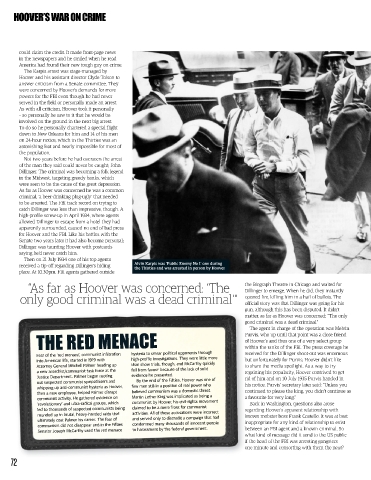
         Then on 21 July 1934 one of his top agents
                                                Alvin Karpis was ÔPublic Enemy No 1’ one during
        received a tip-off regarding Dillinger’s hiding
                                                the Thirties and was arrested in person by Hoover
        place. At 10.30pm, FBI agents gathered outside
           “As far as Hoover was concerned: ‘The                                       the Biograph Theatre in Chicago and waited for
                                                                                       Dillinger to emerge. When he did, they instantly
        only good criminal was a dead criminal’”                                       opened fire, killing him in a hail of bullets. The
                                                                                       official story was that Dillinger was going for his
                                                                                       gun, although this has been disputed. It didn’t
                                                                                       matter, as far as Hoover was concerned: “The only
                                                                                       good criminal was a dead criminal.”
                                                                                         The agent in charge of the operation was Melvin
                                                                                       Purvis, who up until that point was a close friend
              THE RED MENACE                                                           of Hoover’s and thus one of a very select group
                                                                                       within the ranks of the FBI. The press coverage he
              Fear of the ‘red menace’, communist infiltration   hysteria to smear political opponents through   received for the Dillinger shoot-out was enormous
              into American life, started in 1919 with   high-profile investigations. They were little more   but unfortunately for Purvis, Hoover didn’t like
              Attorney General Mitchell Palmer heading up   than show trials, though, and McCarthy quickly   to share the media spotlight. As a way to try
              a new anarchist/communist task force at the   fell from favour because of the lack of solid   regaining his popularity, Hoover contrived to get
              Justice Department. Palmer began rooting   evidence he presented.        rid of him and on 10 July 1935 Purvis handed in
              out suspected communist sympathisers and   By the end of the Fifties, Hoover was one of
              whipping up anti-communist hysteria as Hoover,   few men still in a position of real power who   his notice. Purvis’ secretary later said: “Unless you
              then a new employee, helped Palmer disrupt   believed communism was a domestic threat.   continued to please the king, you didn’t continue as
              communist activity. He gathered evidence on   Martin Luther King was implicated as being a   a favourite for very long.”
              ‘revolutionary’ and ultra-radical groups, which   communist by Hoover, his civil-rights movement   Back in Washington, questions also arose
              led to thousands of suspected communists being   claimed to be a mere front for communist   regarding Hoover’s apparent relationship with
              rounded up in brutal, heavy-handed raids that   activities. All of these accusations were incorrect   known mobster boss Frank Costello. It was at best
              ultimately cost Palmer his career. The fear of   and served only to discredit a campaign that had
              communism did not disappear and in the Fifties   condemned many thousands of innocent people   inappropriate for any kind of relationship to exist
              Senator Joseph McCarthy used the red menace   to harassment by the federal government.   between an FBI agent and a known criminal. So
                                                                                       what kind of message did it send to the US public
                                                                                       if the head of the FBI was arresting gangsters
                                                                                       one minute and consorting with them the next?
     72

