


Page 75 - Nilam_Publication_module_Chemistry_Form.pdf
P. 75
Chemistry Form 4 • MODULE

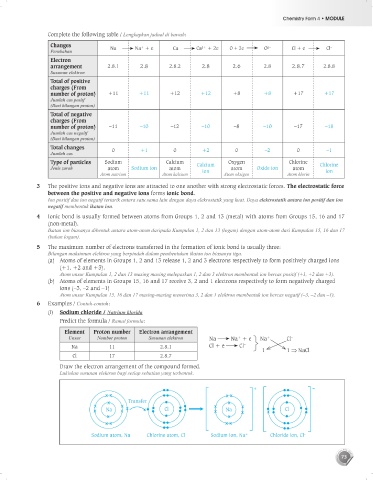
                    Complete the following table / Lengkapkan jadual di bawah:
                     Changes             Na      Na  + e       Ca     Ca  + 2e    O + 2e     O         Cl + e     Cl –
                                                   +
                                                                                              2–
                                                                        2+
                     Perubahan
                     Electron
                     arrangement        2.8.1      2.8       2.8.2      2.8        2.6       2.8       2.8.7     2.8.8
                     Susunan elektron
                     Total of positive
                     charges (From
                     number of proton)  +11        +11       +12        +12        +8        +8        +17        +17
                     Jumlah cas positf
                     (Dari bilangan proton)
                     Total of negative
                     charges (From
                     number of proton)   –11       –10        –12       –10        –8        –10        –17       –18
                     Jumlah cas negaitf
                     (Dari bilangan proton)
                     Total changes       0         +1         0         +2         0         –2         0         –1
                     Jumlah cas
                     Type of particles  Sodium              Calcium   Calcium    Oxygen               Chlorine   Chlorine
                     Jenis zarah        atom    Sodium ion   atom       ion       atom     Oxide ion   atom       ion
                                      Atom natrium         Atom kalsium         Atom oksigen         Atom klorin
                3   The positive ions and negative ions are attracted to one another with strong electrostatic forces. The electrostatic force
                    between the positive and negative ions forms ionic bond.
                    Ion positif dan ion negatif tertarik antara satu sama lain dengan daya elekrostatik yang kuat. Daya elektrostatik antara ion positif dan ion
                    negatif membentuk ikatan ion.
                4   Ionic bond is usually formed between atoms from Groups 1, 2 and 13 (metal) with atoms from Groups 15, 16 and 17
                    (non-metal).
                    Ikatan ion biasanya dibentuk antara atom-atom daripada Kumpulan 1, 2 dan 13 (logam) dengan atom-atom dari Kumpulan 15, 16 dan 17
                    (bukan logam).
                5   The maximum number of electrons transferred in the formation of ionic bond is usually three:
                    Bilangan maksimum elektron yang berpindah dalam pembentukan ikatan ion biasanya tiga.
                    (a)  Atoms of elements in Groups 1, 2 and 13 release 1, 2 and 3 electrons respectively to form positively charged ions
                        (+1, +2 and +3).
                        Atom unsur Kumpulan 1, 2 dan 13 masing masing melepaskan 1, 2 dan 3 elektron membentuk ion bercas positif (+1, +2 dan +3).
                    (b)  Atoms of elements in Groups 15, 16 and 17 receive 3, 2 and 1 electrons respectively to form negatively charged
                        ions (–3, –2 and –1)
                        Atom unsur Kumpulan 15, 16 dan 17 masing-masing menerima 3, 2 dan 1 elektron membentuk ion bercas negatif (–3, –2 dan –1).
                6   Examples / Contoh-contoh:
                    (i)  Sodium chloride / Natrium klorida
                        Predict the formula / Ramal formula:
                         Element   Proton number   Electron arrangement
                                                                                    +
                           Unsur    Nombor proton     Susunan elektron     Na     Na  + e   Na +     Cl –
                            Na           11               2.8.1            Cl + e    Cl –
                                                                                             1       1   NaCl
                            Cl           17               2.8.7
                        Draw the electron arrangement of the compound formed.
                        Lukiskan susunan elektron bagi setiap sebatian yang terbentuk.


                                               Transfer
                                               Pindah
                                                                                Na
                                       Na Na               C1 Cl                Na                  C1 Cl


                                                                                               Chloride ion, Cl
                                  Sodium atom, Na
                                                                           Sodium ion, Na
                                  Atom natrium, Na   Chlorine atom, Cl    Ion natrium, Na + +  Ion klorida, Cl – –
                                                      Atom klorin, Cl

                                                                                                                        73
                                                                                                                         Nilam Publication Sdn. Bhd.

        04-Chem F4 (3P).indd   73                                                                                  12/9/2011   5:57:09 PM

