


Page 71 - Nilam_Publication_module_Chemistry_Form.pdf
P. 71
Chemistry Form 4 • MODULE

                    (f)  State the arrangement of elements T, U and V in the order of increasing atomic radius. Explain your answer.
                        Nyatakan susunan unsur T, U dan V dalam tertib pertambahan jejari atom. Terangkan jawapan anda.
                        V, U and T. Atoms of T, U, and V have three shells occupied with electrons.
                        The proton number // positive charges in the nucleus increases from T to V.

                        The forces of attraction between proton in the nucleus and the electrons in the shells increase from T to V.
                        The shells filled with electrons are pulled nearer to the nucleus from T to V.

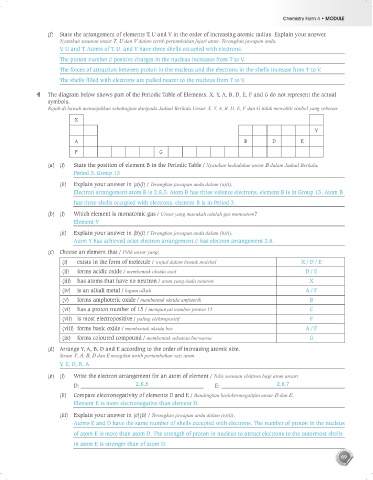
                4   The diagram below shows part of the Periodic Table of Elements. X, Y, A, B, D, E, F and G do not represent the actual
                    symbols.
                    Rajah di bawah menunjukkan sebahagian daripada Jadual Berkala Unsur. X, Y, A, B, D, E, F dan G tidak mewakili simbol yang sebenar.
                             X
                                                                                                               Y

                             A                                                         B        D         E
                             F                            G

                    (a)  (i)   State the position of element B in the Periodic Table / Nyatakan kedudukan unsur B dalam Jadual Berkala.
                             Period 3, Group 13
                        (ii)  Explain your answer in (a)(i) / Terangkan jawapan anda dalam (a)(i).
                             Electron arrangement atom B is 2.8.3. Atom B has three valence electrons, element B is in Group 13. Atom B
                             has three shells occupied with electrons, element B is in Period 3.
                    (b)  (i)   Which element is monatomic gas / Unsur yang manakah adalah gas monoatom?
                             Element Y
                        (ii)  Explain your answer in (b)(i) / Terangkan jawapan anda dalam (b)(i).
                             Atom Y has achieved octet electron arrangement // has electron arrangement 2.8.
                    (c)  Choose an element that / Pilih unsur yang:
                         (i)  exists in the form of molecule / wujud dalam bentuk molekul                 X / D / E
                         (ii)  forms acidic oxide / membentuk oksida asid                                  D / E
                         (iii)  has atoms that have no neutron / atom yang tiada neutron                     X
                         (iv)  is an alkali metal / logam alkali                                           A / F
                         (v)  forms amphoteric oxide / membentuk oksida amfoterik                            B
                         (vi)  has a proton number of 15 / mempunyai nombor proton 15                        C
                         (vii) is most electropositive / paling elektropositif                               F
                         (viii) forms basic oxide / membentuk oksida bes                                   A / F
                         (ix)  forms coloured compound / membentuk sebatian berwarna                         G

                    (d)  Arrange Y, A, B, D and E according to the order of increasing atomic size.
                        Susun Y, A, B, D dan E mengikut tertib pertambahan saiz atom.
                        Y, E, D, B, A
                    (e)  (i)   Write the electron arrangement for an atom of element / Tulis susunan elektron bagi atom unsur:
                             D:                   2.8.5                      E:                   2.8.7
                        (ii)  Compare electronegativity of elements D and E / Bandingkan keelektronegatifan unsur D dan E.
                             Element E is more electronegative than element D.

                        (iii)  Explain your answer in (e)(ii) / Terangkan jawapan anda dalam (e)(ii).
                             Atoms E and D have the same number of shells occupied with electrons. The number of proton in the nucleus

                             of atom E is more than atom D. The strength of proton in nucleus to attract electrons to the outermost shells
                             in atom E is stronger than of atom D.

                                                                                                                        69
                                                                                                                         Nilam Publication Sdn. Bhd.


        03-Chem F4 (3P).indd   69                                                                                  12/9/2011   5:57:57 PM

