


Page 45 - Journeys2017_Student_Edition_Grade5_Unit4_removed
P. 45
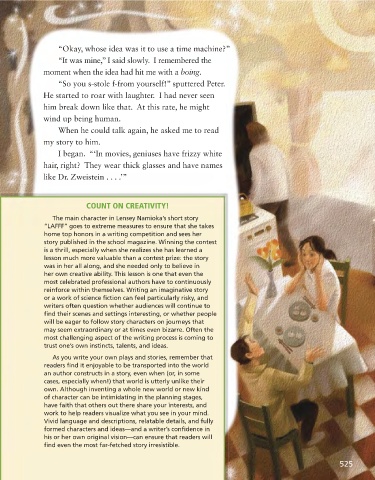
“Okay, whose idea was it to use a time machine?”

     “It was mine,” I said slowly. I remembered the

moment when the idea had hit me with a boing.

     “So you s-stole f-from yourself!” sputtered Peter.

He started to roar with laughter. I had never seen

him break down like that. At this rate, he might

wind up being human.

     When he could talk again, he asked me to read

my story to him.

     I began. “‘In movies, geniuses have frizzy white

hair, right? They wear thick glasses and have names

like Dr. Zweistein . . . .’”

                COUNT ON CREATIVITY!

    The main character in Lensey Namioka’s short story
“LAFFF” goes to extreme measures to ensure that she takes
home top honors in a writing competition and sees her
story published in the school magazine. Winning the contest
is a thrill, especially when she realizes she has learned a
lesson much more valuable than a contest prize: the story
was in her all along, and she needed only to believe in
her own creative ability. This lesson is one that even the
most celebrated professional authors have to continuously
reinforce within themselves. Writing an imaginative story
or a work of science fiction can feel particularly risky, and
writers often question whether audiences will continue to
find their scenes and settings interesting, or whether people
will be eager to follow story characters on journeys that
may seem extraordinary or at times even bizarre. Often the
most challenging aspect of the writing process is coming to
trust one’s own instincts, talents, and ideas.

    As you write your own plays and stories, remember that
readers find it enjoyable to be transported into the world
an author constructs in a story, even when (or, in some
cases, especially when!) that world is utterly unlike their
own. Although inventing a whole new world or new kind
of character can be intimidating in the planning stages,
have faith that others out there share your interests, and
work to help readers visualize what you see in your mind.
Vivid language and descriptions, relatable details, and fully
formed characters and ideas—and a writer’s confidence in
his or her own original vision—can ensure that readers will
find even the most far-fetched story irresistible.

                                                               525

