


Page 25 - BE Mech Curriculum and Syllabus - R2017 - REC
P. 25
Department of MECH | REC
To study the integrated themes and biodiversity, natural resources, pollution control and waste
management.
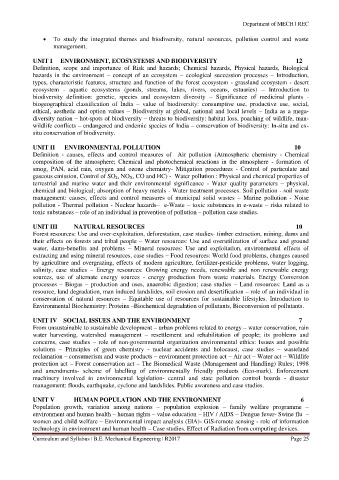
UNIT I ENVIRONMENT, ECOSYSTEMS AND BIODIVERSITY 12
Definition, scope and importance of Risk and hazards; Chemical hazards, Physical hazards, Biological
hazards in the environment – concept of an ecosystem – ecological succession processes – Introduction,
types, characteristic features, structure and function of the forest ecosystem - grassland ecosystem - desert
ecosystem - aquatic ecosystems (ponds, streams, lakes, rivers, oceans, estuaries) – Introduction to
biodiversity definition: genetic, species and ecosystem diversity – Significance of medicinal plants -
biogeographical classification of India – value of biodiversity: consumptive use, productive use, social,
ethical, aesthetic and option values – Biodiversity at global, national and local levels – India as a mega-
diversity nation – hot-spots of biodiversity – threats to biodiversity: habitat loss, poaching of wildlife, man-
wildlife conflicts – endangered and endemic species of India – conservation of biodiversity: In-situ and ex-
situ conservation of biodiversity.
UNIT II ENVIRONMENTAL POLLUTION 10
Definition - causes, effects and control measures of Air pollution (Atmospheric chemistry - Chemical
composition of the atmosphere; Chemical and photochemical reactions in the atmosphere - formation of
smog, PAN, acid rain, oxygen and ozone chemistry- Mitigation procedures - Control of particulate and
gaseous emission, Control of SO2, NOX, CO and HC) - Water pollution : Physical and chemical properties of
terrestrial and marine water and their environmental significance - Water quality parameters – physical,
chemical and biological; absorption of heavy metals - Water treatment processes. Soil pollution - soil waste
management: causes, effects and control measures of municipal solid wastes – Marine pollution - Noise
pollution - Thermal pollution - Nuclear hazards– e-Waste – toxic substances in e-waste – risks related to
toxic substances – role of an individual in prevention of pollution – pollution case studies.
UNIT III NATURAL RESOURCES 10
Forest resources: Use and over-exploitation, deforestation, case studies- timber extraction, mining, dams and
their effects on forests and tribal people – Water resources: Use and overutilization of surface and ground
water, dams-benefits and problems – Mineral resources: Use and exploitation, environmental effects of
extracting and using mineral resources, case studies – Food resources: World food problems, changes caused
by agriculture and overgrazing, effects of modern agriculture, fertilizer-pesticide problems, water logging,
salinity, case studies – Energy resources: Growing energy needs, renewable and non renewable energy
sources, use of alternate energy sources - energy production from waste materials. Energy Conversion
processes – Biogas – production and uses, anaerobic digestion; case studies – Land resources: Land as a
resource, land degradation, man induced landslides, soil erosion and desertification – role of an individual in
conservation of natural resources – Equitable use of resources for sustainable lifestyles. Introduction to
Environmental Biochemistry: Proteins –Biochemical degradation of pollutants, Bioconversion of pollutants.
UNIT IV SOCIAL ISSUES AND THE ENVIRONMENT 7
From unsustainable to sustainable development – urban problems related to energy – water conservation, rain
water harvesting, watershed management – resettlement and rehabilitation of people; its problems and
concerns, case studies – role of non-governmental organization environmental ethics: Issues and possible
solutions – Principles of green chemistry - nuclear accidents and holocaust, case studies – wasteland
reclamation – consumerism and waste products – environment protection act – Air act – Water act – Wildlife
protection act – Forest conservation act – The Biomedical Waste (Management and Handling) Rules; 1998
and amendments- scheme of labelling of environmentally friendly products (Eco-mark). Enforcement
machinery involved in environmental legislation- central and state pollution control boards - disaster
management: floods, earthquake, cyclone and landslides. Public awareness and case studies.
UNIT V HUMAN POPULATION AND THE ENVIRONMENT 6
Population growth, variation among nations – population explosion – family welfare programme –
environment and human health – human rights – value education – HIV / AIDS – Dengue fever- Swine flu –
women and child welfare – Environmental impact analysis (EIA)- GIS-remote sensing - role of information
technology in environment and human health – Case studies. Effect of Radiation from computing devices.
Curriculum and Syllabus | B.E. Mechanical Engineering | R2017 Page 25

