


Page 20 - REC :: M.E. Embedded System Technologies Curriculum and Syllabus - R2019
P. 20
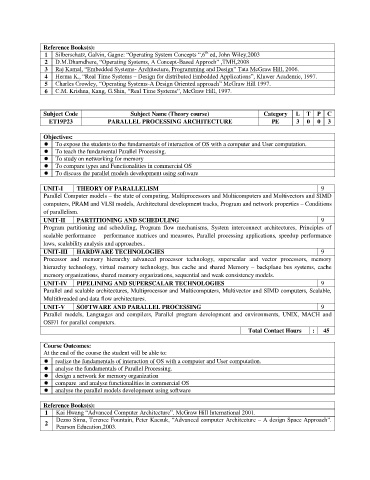
Reference Books(s):
th
1 Silberschatz, Galvin, Gagne: “Operating System Concepts “,6 ed, John Wiley,2003
2 D.M.Dhamdhere, “Operating Systems, A Concept-Based Approch” ,TMH,2008
3 Raj Kamal, “Embedded Systems- Architecture, Programming and Design” Tata McGraw Hill, 2006.
4 Herma K., “Real Time Systems – Design for distributed Embedded Applications”, Kluwer Academic, 1997.
5 Charles Crowley, “Operating Systems-A Design Oriented approach” McGraw Hill 1997.
6 C.M. Krishna, Kang, G.Shin, “Real Time Systems”, McGraw Hill, 1997.
Subject Code Subject Name (Theory course) Category L T P C
ET19P23 PARALLEL PROCESSING ARCHITECTURE PE 3 0 0 3
Objectives:
To expose the students to the fundamentals of interaction of OS with a computer and User computation.
To teach the fundamental Parallel Processing.
To study on networking for memory
To compare types and Functionalities in commercial OS
To discuss the parallel models development using software
UNIT-I THEORY OF PARALLELISM 9
Parallel Computer models – the state of computing, Multiprocessors and Multicomputers and Multivectors and SIMD
computers, PRAM and VLSI models, Architectural development tracks, Program and network properties – Conditions
of parallelism.
UNIT-II PARTITIONING AND SCHEDULING 9
Program partitioning and scheduling, Program flow mechanisms, System interconnect architectures, Principles of
scalable performance – performance matrices and measures, Parallel processing applications, speedup performance
laws, scalability analysis and approaches..
UNIT-III HARDWARE TECHNOLOGIES 9
Processor and memory hierarchy advanced processor technology, superscalar and vector processors, memory
hierarchy technology, virtual memory technology, bus cache and shared Memory – backplane bus systems, cache
memory organizations, shared memory organizations, sequential and weak consistency models.
UNIT-IV PIPELINING AND SUPERSCALAR TECHNOLOGIES 9
Parallel and scalable architectures, Multiprocessor and Multicomputers, Multivector and SIMD computers, Scalable,
Multithreaded and data flow architectures.
UNIT-V SOFTWARE AND PARALLEL PROCESSING 9
Parallel models, Languages and compilers, Parallel program development and environments, UNIX, MACH and
OSF/1 for parallel computers.
Total Contact Hours : 45
Course Outcomes:
At the end of the course the student will be able to:
realize the fundamentals of interaction of OS with a computer and User computation.
analyse the fundamentals of Parallel Processing.
design a network for memory organization
compare and analyse functionalities in commercial OS
analyse the parallel models development using software
Reference Books(s):
1 Kai Hwang “Advanced Computer Architecture”. McGraw Hill International 2001.
Dezso Sima, Terence Fountain, Peter Kacsuk, “Advanced computer Architecture – A design Space Approach”.
2
Pearson Education,2003.

