


Page 7 - REC :: M.E. Embedded System Technologies Curriculum and Syllabus - R2019
P. 7
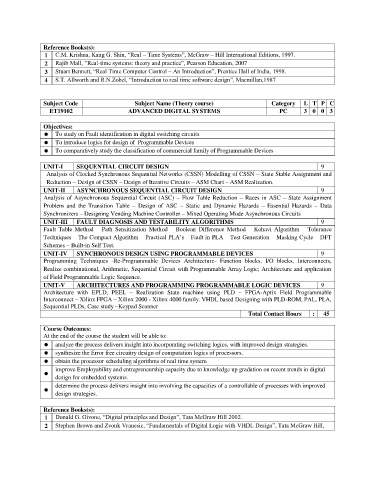
Reference Books(s):
1 C.M. Krishna, Kang G. Shin, “Real – Time Systems”, McGraw – Hill International Editions, 1997.
2 Rajib Mall, ”Real-time systems: theory and practice”, Pearson Education, 2007
3 Stuart Bennett, “Real Time Computer Control – An Introduction”, Prentice Hall of India, 1998.
4 S.T. Allworth and R.N.Zobel, “Introduction to real time software design”, Macmillan,1987
Subject Code Subject Name (Theory course) Category L T P C
ET19102 ADVANCED DIGITAL SYSTEMS PC 3 0 0 3
Objectives:
To study on Fault identification in digital switching circuits
To introduce logics for design of Programmable Devices
To comparatively study the classification of commercial family of Programmable Devices
UNIT-I SEQUENTIAL CIRCUIT DESIGN 9
Analysis of Clocked Synchronous Sequential Networks (CSSN) Modelling of CSSN – State Stable Assignment and
Reduction – Design of CSSN – Design of Iterative Circuits – ASM Chart – ASM Realization.
UNIT-II ASYNCHRONOUS SEQUENTIAL CIRCUIT DESIGN 9
Analysis of Asynchronous Sequential Circuit (ASC) – Flow Table Reduction – Races in ASC – State Assignment
Problem and the Transition Table – Design of ASC – Static and Dynamic Hazards – Essential Hazards – Data
Synchronizers – Designing Vending Machine Controller – Mixed Operating Mode Asynchronous Circuits
UNIT-III FAULT DIAGNOSIS AND TESTABILITY ALGORITHMS 9
Fault Table Method – Path Sensitization Method – Boolean Difference Method – Kohavi Algorithm – Tolerance
Techniques – The Compact Algorithm – Practical PLA’s – Fault in PLA – Test Generation – Masking Cycle – DFT
Schemes – Built-in Self Test.
UNIT-IV SYNCHRONOUS DESIGN USING PROGRAMMABLE DEVICES 9
Programming Techniques -Re-Programmable Devices Architecture- Function blocks, I/O blocks, Interconnects,
Realize combinational, Arithmetic, Sequential Circuit with Programmable Array Logic; Architecture and application
of Field Programmable Logic Sequence.
UNIT-V ARCHITECTURES AND PROGRAMMING PROGRAMMABLE LOGIC DEVICES 9
Architecture with EPLD, PEEL – Realization State machine using PLD – FPGA-Aptix Field Programmable
Interconnect – Xilinx FPGA – Xilinx 2000 - Xilinx 4000 family. VHDL based Designing with PLD-ROM, PAL, PLA,
Sequential PLDs, Case study –Keypad Scanner
Total Contact Hours : 45
Course Outcomes:
At the end of the course the student will be able to:
analyze the process delivers insight into incorporating switching logics, with improved design strategies.
synthesize the Error free circuitry design of computation logics of processors.
obtain the processor scheduling algorithms of real time system
improve Employability and entrepreneurship capacity due to knowledge up gradation on recent trends in digital
design for embedded systems.
determine the process delivers insight into involving the capacities of a controllable of processes with improved
design strategies.
Reference Books(s):
1 Donald G. Givone, “Digital principles and Design”, Tata McGraw Hill 2002.
2 Stephen Brown and Zvonk Vranesic, “Fundamentals of Digital Logic with VHDL Design”, Tata McGraw Hill,

