


Page 12 - REC :: M.E. Embedded System Technologies Curriculum and Syllabus - R2019
P. 12
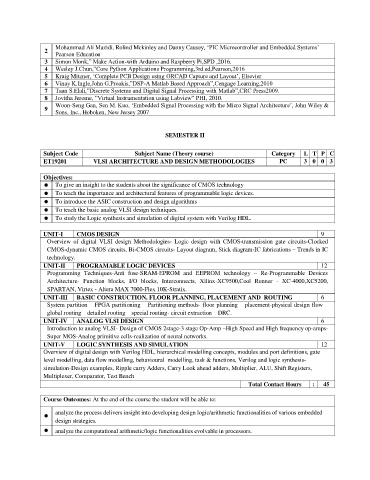
Mohammad Ali Mazidi, Rolind Mckinley and Danny Causey, ‘PIC Microcontroller and Embedded Systems’
2
Pearson Education
3 Simon Monk,” Make Action-with Arduino and Raspberry Pi,SPD ,2016.
4 Wesley J.Chun,”Core Python Applications Programming,3rd ed,Pearson,2016
5 Kraig Mitzner, ‘Complete PCB Design using ORCAD Capture and Layout’, Elsevier
6 Vinay K.Ingle,John G.Proakis,”DSP-A Matlab Based Approach”,Cengage Learning,2010
7 Taan S.Elali,”Discrete Systems and Digital Signal Processing with Matlab”,CRC Press2009.
8 Jovitha Jerome, ”Virtual Instrumentation using Labview” PHI, 2010.
Woon-Seng Gan, Sen M. Kuo, ‘Embedded Signal Processing with the Micro Signal Architecture’, John Wiley &
9
Sons, Inc., Hoboken, New Jersey 2007
SEMESTER II
Subject Code Subject Name (Theory course) Category L T P C
ET19201 VLSI ARCHITECTURE AND DESIGN METHODOLOGIES PC 3 0 0 3
Objectives:
To give an insight to the students about the significance of CMOS technology
To teach the importance and architectural features of programmable logic devices.
To introduce the ASIC construction and design algorithms
To teach the basic analog VLSI design techniques.
To study the Logic synthesis and simulation of digital system with Verilog HDL.
UNIT-I CMOS DESIGN 9
Overview of digital VLSI design Methodologies- Logic design with CMOS-transmission gate circuits-Clocked
CMOS-dynamic CMOS circuits, Bi-CMOS circuits- Layout diagram, Stick diagram-IC fabrications – Trends in IC
technology.
UNIT-II PROGRAMABLE LOGIC DEVICES 12
Programming Techniques-Anti fuse-SRAM-EPROM and EEPROM technology – Re-Programmable Devices
Architecture- Function blocks, I/O blocks, Interconnects, Xilinx-XC9500,Cool Runner - XC-4000,XC5200,
SPARTAN, Virtex - Altera MAX 7000-Flex 10K-Stratix.
UNIT-III BASIC CONSTRUCTION, FLOOR PLANNING, PLACEMENT AND ROUTING 6
System partition – FPGA partitioning – Partitioning methods- floor planning – placement-physical design flow –
global routing – detailed routing – special routing- circuit extraction – DRC.
UNIT-IV ANALOG VLSI DESIGN 6
Introduction to analog VLSI- Design of CMOS 2stage-3 stage Op-Amp –High Speed and High frequency op-amps-
Super MOS-Analog primitive cells-realization of neural networks.
UNIT-V LOGIC SYNTHESIS AND SIMULATION 12
Overview of digital design with Verilog HDL, hierarchical modelling concepts, modules and port definitions, gate
level modelling, data flow modelling, behavioural modelling, task & functions, Verilog and logic synthesis-
simulation-Design examples, Ripple carry Adders, Carry Look ahead adders, Multiplier, ALU, Shift Registers,
Multiplexer, Comparator, Test Bench
Total Contact Hours : 45
Course Outcomes: At the end of the course the student will be able to:
analyze the process delivers insight into developing design logic/arithmetic functionalities of various embedded
design strategies.
analyze the computational arithmetic/logic functionalities evolvable in processors.

