


Page 33 - B.E Civil Curriculum and Syllabus R2017 - REC
P. 33
Department of Civil Engineering, REC
CE17211 COMPUTER AIDED BUILDING DRAWING L T P C
0 0 4 2
OBJECTIVE:
To introduce the students to draft the plan, elevation and sectional views of buildings in accordance
with development and control rules satisfying orientation and functional requirements as per
National Building Code.
LIST OF EXPERIMENTS
1. Principles of planning, orientation and complete joinery details (Paneled and Glazed Doors and
Windows)
2. Buildings with load bearing walls
3. Buildings with sloping roof
4. R.C.C. framed structures.
5. Industrial buildings – North light roof structures
6. BIM
TOTAL: 60 PERIODS
OUTCOME:
Upon the completion of the course, the students will be able to
Draft the plan, elevation and sectional views of the buildings, industrial structures and framed
buildings using computer software.
TEXTBOOKS:
th
Sikka V.B., A Course in Civil Engineering Drawing, 4 Edition, S.K.Kataria and Sons, 2015.
George Omura, Mastering in AutoCAD 2005 and AutoCAD LT 2005– BPB Publications.
REFERENCES:
1. Chuck Eastman, Paul Teicholz, Rafael Sacks, Kathleen Liston, BIM Hand book: A Guide to building
information modeling for Owners, Managers, Designers, Engineers, and Contractors, John Wiley and
Sons. Inc., 2011.
2. Marimuthu V.M., Murugesan R. and Padmini S., Civil Engineering Drawing-I, Pratheeba Publishers,
2008.
3. Shah M.G, Kale. C.M. and Patki.S.Y., Building Drawing with an Integrated Approach to Built
Environment, Tata McGraw Hill Publishers Limited, 2007.
4. Verma B.P., Civil Engineering Drawing and House Planning, Khanna Publishers, 2010
MA 17351 TRANSFORMS AND PARTIAL DIFFERENTIAL L T P C
EQUATIONS 3 2 0 4
OBJECTIVES
To introduce Fourier series which is central to many applications in engineering apart from its use in
solving boundary value problems.
To acquaint the student with Fourier transform techniques used in wide variety of situations.
To introduce the effective mathematical tools for the solutions of partial differential equations that
model several physical processes and to develop Z transform techniques for discrete time systems.
UNIT I PARTIAL DIFFERENTIAL EQUATIONS 15
Formation of partial differential equations – Singular integrals -- Solutions of standard types of first order
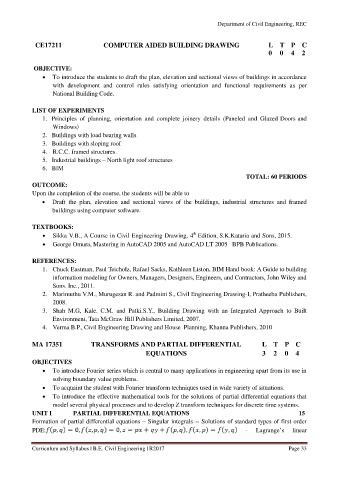
PDE: - Lagrange‘s linear
Curriculum and Syllabus | B.E. Civil Engineering | R2017 Page 33

