


Page 22 - REC :: B.E. EEE Curriculum and Syllabus - R2019
P. 22
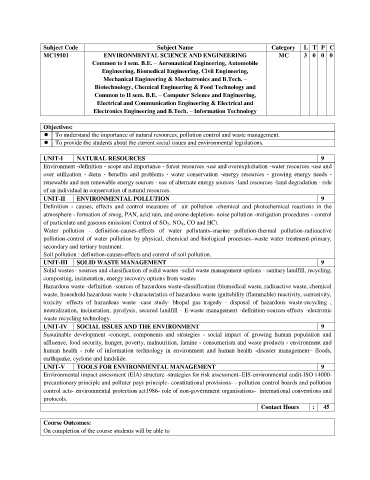
Subject Code Subject Name Category L T P C
MC19101 ENVIRONMENTAL SCIENCE AND ENGINEERING MC 3 0 0 0
Common to I sem. B.E. – Aeronautical Engineering, Automobile
Engineering, Biomedical Engineering, Civil Engineering,
Mechanical Engineering & Mechatronics and B.Tech. –
Biotechnology, Chemical Engineering & Food Technology and
Common to II sem. B.E. – Computer Science and Engineering,
Electrical and Communication Engineering & Electrical and
Electronics Engineering and B.Tech. – Information Technology
Objectives:
To understand the importance of natural resources, pollution control and waste management.
To provide the students about the current social issues and environmental legislations.
UNIT-I NATURAL RESOURCES 9
Environment -definition - scope and importance - forest resources -use and overexploitation -water resources -use and
over utilization - dams - benefits and problems - water conservation -energy resources - growing energy needs -
renewable and non renewable energy sources - use of alternate energy sources -land resources -land degradation - role
of an individual in conservation of natural resources.
UNIT-II ENVIRONMENTAL POLLUTION 9
Definition - causes, effects and control measures of air pollution -chemical and photochemical reactions in the
atmosphere - formation of smog, PAN, acid rain, and ozone depletion- noise pollution -mitigation procedures - control
of particulate and gaseous emission( Control of SO 2, NO X, CO and HC).
Water pollution - definition-causes-effects of water pollutants–marine pollution-thermal pollution-radioactive
pollution-control of water pollution by physical, chemical and biological processes–waste water treatment-primary,
secondary and tertiary treatment.
Soil pollution : definition-causes-effects and control of soil pollution.
UNIT-III SOLID WASTE MANAGEMENT 9
Solid wastes - sources and classification of solid wastes -solid waste management options - sanitary landfill, recycling,
composting, incineration, energy recovery options from wastes
Hazardous waste -definition -sources of hazardous waste-classification (biomedical waste, radioactive waste, chemical
waste, household hazardous waste )-characteristics of hazardous waste ignitability (flammable) reactivity, corrosivity,
toxicity -effects of hazardous waste -case study- bhopal gas tragedy - disposal of hazardous waste-recycling ,
neutralization, incineration, pyrolysis, secured landfill - E-waste management -definition-sources-effects -electronic
waste recycling technology.
UNIT-IV SOCIAL ISSUES AND THE ENVIRONMENT 9
Sustainable development -concept, components and strategies - social impact of growing human population and
affluence, food security, hunger, poverty, malnutrition, famine - consumerism and waste products - environment and
human health - role of information technology in environment and human health -disaster management– floods,
earthquake, cyclone and landslide.
UNIT-V TOOLS FOR ENVIRONMENTAL MANAGEMENT 9
Environmental impact assessment (EIA) structure -strategies for risk assessment–EIS-environmental audit-ISO 14000-
precautionary principle and polluter pays principle- constitutional provisions- - pollution control boards and pollution
control acts- environmental protection act1986- role of non-government organisations- international conventions and
protocols.
Contact Hours : 45
Course Outcomes:
On completion of the course students will be able to

