


Page 11 - REC :: M.E. CSE Curriculum and Syllabus - R2019
P. 11
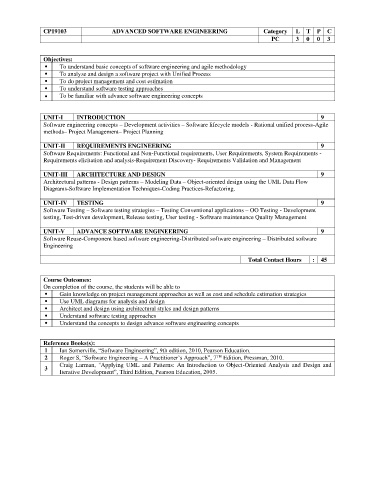
CP19103                ADVANCED SOFTWARE ENGINEERING                     Category   L  T  P  C
                                                                                           PC      3   0   0  3


               Objectives:
                ⚫    To understand basic concepts of software engineering and agile methodology
                ⚫    To analyze and design a software project with Unified Process
                ⚫    To do project management and cost estimation
                ⚫    To understand software testing approaches
                     To be familiar with advance software engineering concepts
                ⚫


               UNIT-I     INTRODUCTION                                                                     9
               Software engineering concepts – Development activities – Software lifecycle models - Rational unified process-Agile
               methods– Project Management– Project Planning

               UNIT-II    REQUIREMENTS ENGINEERING                                                         9
               Software Requirements: Functional and Non-Functional requirements, User Requirements, System Requirements -
               Requirements elicitation and analysis-Requirement Discovery- Requirements Validation and Management

               UNIT-III   ARCHITECTURE AND DESIGN                                                          9
               Architectural patterns - Design patterns – Modeling Data – Object-oriented design using the UML Data Flow
               Diagrams-Software Implementation Techniques-Coding Practices-Refactoring.

               UNIT-IV    TESTING                                                                          9
               Software Testing – Software testing strategies – Testing Conventional applications – OO Testing - Development
               testing, Test-driven development, Release testing, User testing - Software maintenance Quality Management

               UNIT-V     ADVANCE SOFTWARE ENGINEERING                                                     9
               Software Reuse-Component based software engineering-Distributed software engineering – Distributed software
               Engineering

                                                                                   Total Contact Hours   :  45


               Course Outcomes:
               On completion of the course, the students will be able to
                ⚫    Gain knowledge on project management approaches as well as cost and schedule estimation strategies
                ⚫    Use UML diagrams for analysis and design
                ⚫    Architect and design using architectural styles and design patterns
                ⚫    Understand software testing approaches
                ⚫    Understand the concepts to design advance software engineering concepts

               Reference Books(s):
                1    Ian Somerville, “Software Engineering”, 9th edition, 2010, Pearson Education.
                                                                         TH
                2    Roger S, “Software Engineering – A Practitioner’s Approach”, 7  Edition, Pressman, 2010.
                     Craig  Larman,  "Applying  UML  and  Patterns:  An  Introduction  to  Object-Oriented  Analysis  and  Design  and
                3
                     Iterative Development”, Third Edition, Pearson Education, 2005.

