


Page 34 - REC :: M.E. CSE Curriculum and Syllabus - R2019
P. 34
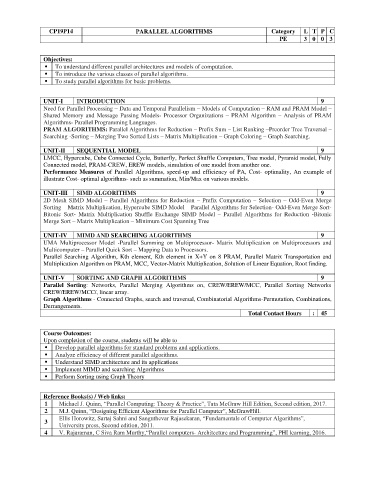
CP19P14                      PARALLEL ALGORITHMS                          Category   L  T  P  C
                                                                                              PE      3  0  0  3


               Objectives:
                ⚫   To understand different parallel architectures and models of computation.
                ⚫   To introduce the various classes of parallel algorithms.
                ⚫   To study parallel algorithms for basic problems.

               UNIT-I     INTRODUCTION                                                                     9
               Need for Parallel Processing – Data and Temporal Parallelism – Models of Computation – RAM and PRAM Model –
               Shared Memory and Message  Passing Models- Processor Organizations  – PRAM Algorithm  – Analysis of PRAM
               Algorithms- Parallel Programming Languages.
               PRAM ALGORITHMS: Parallel Algorithms for Reduction – Prefix Sum – List Ranking –Preorder Tree Traversal –
               Searching -Sorting – Merging Two Sorted Lists – Matrix Multiplication – Graph Coloring – Graph Searching.

               UNIT-II    SEQUENTIAL MODEL                                                                 9
               LMCC, Hypercube, Cube Connected Cycle, Butterfly, Perfect Shuffle Computers, Tree model, Pyramid model, Fully
               Connected model, PRAM-CREW, EREW models, simulation of one model from another one.
               Performance  Measures  of  Parallel  Algorithms,  speed-up  and  efficiency  of  PA,  Cost-  optimality,  An  example  of
               illustrate Cost- optimal algorithms- such as summation, Min/Max on various models.

               UNIT-III   SIMD ALGORITHMS                                                                  9
               2D Mesh SIMD Model – Parallel Algorithms for Reduction  – Prefix Computation – Selection – Odd-Even Merge
               Sorting – Matrix Multiplication, Hypercube SIMD Model – Parallel Algorithms for Selection- Odd-Even Merge Sort-
               Bitonic  Sort-  Matrix  Multiplication  Shuffle  Exchange  SIMD  Model  –  Parallel  Algorithms  for  Reduction  -Bitonic
               Merge Sort – Matrix Multiplication – Minimum Cost Spanning Tree

               UNIT-IV    MIMD AND SEARCHING ALGORITHMS                                                    9
               UMA  Multiprocessor  Model  -Parallel  Summing  on  Multiprocessor-  Matrix  Multiplication  on  Multiprocessors  and
               Multicomputer – Parallel Quick Sort – Mapping Data to Processors.
               Parallel  Searching  Algorithm,  Kth  element,  Kth  element  in  X+Y  on  8  PRAM,  Parallel  Matrix  Transportation  and
               Multiplication Algorithm on PRAM, MCC, Vector-Matrix Multiplication, Solution of Linear Equation, Root finding.

               UNIT-V     SORTING AND GRAPH ALGORITHMS                                                     9
               Parallel  Sorting:  Networks,  Parallel  Merging  Algorithms  on,  CREW/EREW/MCC,  Parallel  Sorting  Networks
               CREW/EREW/MCC/, linear array.
               Graph Algorithms - Connected Graphs, search and traversal, Combinatorial Algorithms-Permutation, Combinations,
               Derrangements.
                                                                                   Total Contact Hours   :  45


               Course Outcomes:
               Upon completion of the course, students will be able to
                ⚫   Develop parallel algorithms for standard problems and applications.
                   Analyze efficiency of different parallel algorithms.
                ⚫
                   Understand SIMD architecture and its applications
                ⚫
                   Implement MIMD and searching Algorithms
                ⚫
                   Perform Sorting using Graph Theory
                ⚫

               Reference Books(s) / Web links:
                1    Michael J. Quinn, “Parallel Computing: Theory & Practice”, Tata McGraw Hill Edition, Second edition, 2017.
                2    M.J. Quinn, “Designing Efficient Algorithms for Parallel Computer”, McGrawHill.
                     Ellis Horowitz, Sartaj Sahni and Sanguthevar Rajasekaran, “Fundamentals of Computer Algorithms”,
                3
                     University press, Second edition, 2011.
                4    V. Rajaraman, C Siva Ram Murthy,“Parallel computers- Architecture and Programming”, PHI learning, 2016.

