


Page 37 - REC :: M.E. CSE Curriculum and Syllabus - R2019
P. 37
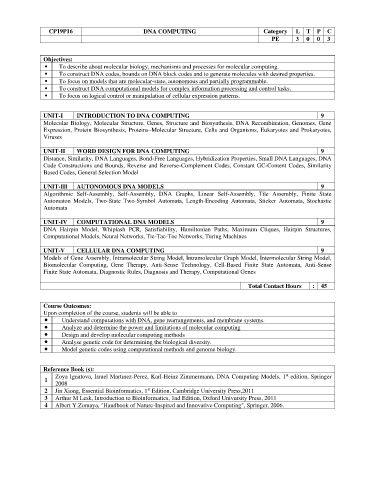
CP19P16                         DNA COMPUTING                          Category   L  T  P  C
                                                                                           PE      3   0   0  3


               Objectives:
                ⚫    To describe about molecular biology, mechanisms and processes for molecular computing.
                ⚫    To construct DNA codes, bounds on DNA block codes and to generate molecules with desired properties.
                ⚫    To focus on models that are molecular-state, autonomous and partially programmable.
                ⚫    To construct DNA computational models for complex information processing and control tasks.
                ⚫    To focus on logical control or manipulation of cellular expression patterns.


               UNIT-I     INTRODUCTION TO DNA COMPUTING                                                    9
               Molecular Biology, Molecular Structure, Genes, Structure and Biosynthesis, DNA Recombination, Genomes, Gene
               Expression, Protein Biosynthesis, Proteins–Molecular Structure, Cells and Organisms, Eukaryotes and Prokaryotes,
               Viruses

               UNIT-II    WORD DESIGN FOR DNA COMPUTING                                                    9
               Distance, Similarity, DNA Languages, Bond-Free Languages, Hybridization Properties, Small DNA Languages, DNA
               Code Constructions and Bounds, Reverse and Reverse-Complement Codes, Constant GC-Content Codes, Similarity
               Based Codes, General Selection Model

               UNIT-III   AUTONOMOUS DNA MODELS                                                            9
               Algorithmic  Self-Assembly,  Self-Assembly,  DNA  Graphs,  Linear  Self-Assembly,  Tile  Assembly,  Finite  State
               Automaton  Models,  Two-State  Two-Symbol  Automata,  Length-Encoding  Automata,  Sticker  Automata,  Stochastic
               Automata

               UNIT-IV    COMPUTATIONAL DNA MODELS                                                         9
               DNA  Hairpin  Model,  Whiplash  PCR,  Satisfiability,  Hamiltonian  Paths,  Maximum  Cliques,  Hairpin  Structures,
               Computational Models, Neural Networks, Tic-Tac-Toe Networks, Turing Machines

               UNIT-V     CELLULAR DNA COMPUTING                                                           9
               Models of Gene Assembly, Intramolecular String Model, Intramolecular Graph Model, Intermolecular String Model,
               Biomolecular  Computing,  Gene  Therapy,  Anti-Sense  Technology,  Cell-Based  Finite  State  Automata,  Anti-Sense
               Finite State Automata, Diagnostic Rules, Diagnosis and Therapy, Computational Genes

                                                                                   Total Contact Hours   :  45

               Course Outcomes:
               Upon completion of the course, students will be able to
                ⚫    Understand computations with DNA, gene rearrangements, and membrane systems.
                ⚫    Analyze and determine the power and limitations of molecular computing
                ⚫    Design and develop molecular computing methods
                ⚫    Analyse genetic code for determining the biological diversity.
                ⚫    Model genetic codes using computational methods and genome biology.


               Reference Book (s):
                                                                                                st
                   Zoya Ignatova, Israel Martınez-Perez, Karl-Heinz Zimmermann, DNA Computing Models, 1  edition, Springer
                1
                   2008
                                                  st
                2   Jin Xiong, Essential Bioinformatics, 1  Edition, Cambridge University Press,2011
                3   Arthur M Lesk, Introduction to Bioinformatics, 1nd Edition, Oxford University Press, 2011
                4   Albert Y.Zomaya, "Handbook of Nature-Inspired and Innovative Computing", Springer, 2006.

