


Page 40 - REC :: M.E. CSE Curriculum and Syllabus - R2019
P. 40
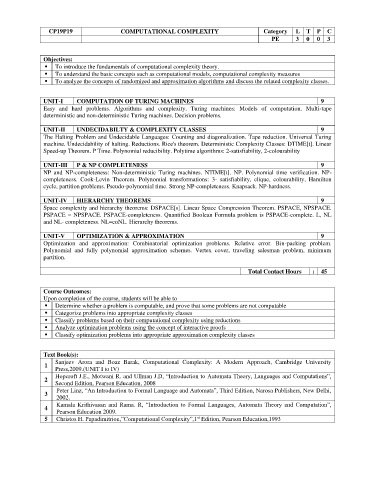
CP19P19                 COMPUTATIONAL COMPLEXITY                       Category   L  T  P  C
                                                                                           PE      3   0   0  3


               Objectives:
                ⚫   To introduce the fundamentals of computational complexity theory.
                ⚫   To understand the basic concepts such as computational models, computational complexity measures
                ⚫   To analyze the concepts of randomized and approximation algorithms and discuss the related complexity classes.

               UNIT-I     COMPUTATION OF TURING MACHINES                                                   9
               Easy  and  hard  problems.  Algorithms  and  complexity.  Turing  machines:  Models  of  computation.  Multi-tape
               deterministic and non-deterministic Turing machines. Decision problems.

               UNIT-II    UNDECIDABILTY & COMPLEXITY CLASSES                                               9
               The Halting Problem and Undecidable Languages: Counting and diagonalization. Tape reduction. Universal Turing
               machine. Undecidability of halting. Reductions. Rice's theorem. Deterministic Complexity Classes: DTIME[t]. Linear
               Speed-up Theorem. P Time. Polynomial reducibility. Polytime algorithms: 2-satisfiability, 2-colourability

               UNIT-III   P & NP COMPLETENESS                                                              9
               NP  and  NP-completeness:  Non-deterministic  Turing  machines.  NTIME[t].  NP.  Polynomial  time  verification.  NP-
               completeness.  Cook-Levin  Theorem.  Polynomial  transformations:  3-  satisfiability,  clique,  colourability,  Hamilton
               cycle, partition problems. Pseudo-polynomial time. Strong NP-completeness. Knapsack. NP-hardness.

               UNIT-IV    HIERARCHY THEOREMS                                                               9
               Space complexity and hierarchy theorems: DSPACE[s]. Linear Space Compression Theorem. PSPACE, NPSPACE.
               PSPACE = NPSPACE. PSPACE-completeness. Quantified Boolean Formula problem is PSPACE-complete. L, NL
               and NL- completeness. NL=coNL. Hierarchy theorems.

               UNIT-V     OPTIMIZATION & APPROXIMATION                                                     9
               Optimization  and  approximation:  Combinatorial  optimization  problems.  Relative  error.  Bin-packing  problem.
               Polynomial  and  fully  polynomial  approximation  schemes.  Vertex  cover,  traveling  salesman  problem,  minimum
               partition.

                                                                                   Total Contact Hours   :  45

               Course Outcomes:
               Upon completion of the course, students will be able to
                ⚫   Determine whether a problem is computable, and prove that some problems are not computable
                ⚫   Categorize problems into appropriate complexity classes
                ⚫   Classify problems based on their computational complexity using reductions
                ⚫   Analyze optimization problems using the concept of interactive proofs
                ⚫   Classify optimization problems into appropriate approximation complexity classes

               Text Book(s):
                   Sanjeev  Arora  and  Boaz  Barak,  Computational  Complexity:  A  Modern  Approach,  Cambridge  University
                1
                   Press,2009.(UNIT I to IV)
                   Hopcroft J.E., Motwani R. and Ullman J.D, “Introduction to Automata Theory, Languages and Computations”,
                2
                   Second Edition, Pearson Education, 2008
                    Peter Linz, “An Introduction to Formal Language and Automata”, Third Edition, Narosa Publishers, New Delhi,
                3
                    2002.
                    Kamala  Krithivasan  and  Rama.  R,  “Introduction  to  Formal  Languages,  Automata  Theory  and  Computation”,
                4
                    Pearson Education 2009.
                                                                  st
                5   Christos H. Papadimitriou,”Computational Complexity”,1  Edition, Pearson Education,1993

