


Page 21 - 6-7-21
P. 21
Risk factors for melanoma                                                                             RURAL-URBAN RECORD, June 7, 2021 Page 21

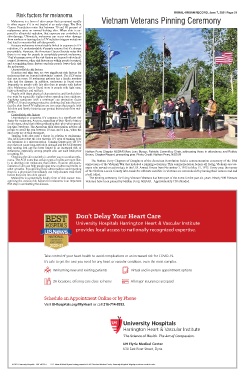
        Melanoma is a form of skin cancer that can spread rapidly   Vietnam Veterans Pinning Ceremony
      to other organs if it is not treated at an early stage. The Skin
      Cancer Foundation notes that between 70 and 80 percent of
      melanomas  arise on normal-looking  skin.  When skin is ex-
      posed to ultraviolet radiation, that exposure can contribute to
      skin damage. Ultimately, melanoma can occur when damage
      from sunburn or tanning due to UV radiation triggers mutations
      that lead to uncontrolled cellular growth.
        Because melanoma is inextricably linked to exposure to UV
      radiation, it’s understandable if people assume that it’s always
      preventable. However, the American Cancer Society notes that
      there is no way for people to completely prevent melanoma.
      That’s because some of the risk factors are beyond individuals’
      control. However, other risk factors are within people’s control,
      and recognizing those factors can help people lower their risk
      for melanoma.
        Uncontrollable risk factors
        Genetics and skin type are two significant risk factors for
      melanoma that are beyond individuals’ control. The SCF notes
      that one in every 10 melanoma patients has a family member
      who  had the disease. In addition, melanoma  is found more
      frequently in people with fair skin than in people with darker
      skin. Melanoma also is found more in people with light eyes,
      light-colored hair and red hair.
        People with these physical characteristics and family histo-
      ries must be especially vigilant when spending time outdoors.
      Applying sunscreen with a minimum  sun protection  factor
      (SPF) of 30 and wearing protective clothing and hats that pro-
      tect the skin from UV radiation are two ways that people with
      fair skin and family histories can protect themselves from mel-
      anoma.
        Controllable risk factors
        Unprotected or excessive UV exposure is a significant risk
      factor for melanoma. Anyone, regardless of their family history
      or skin type, should prioritize protecting their skin when spend-
      ing time outdoors. The American Skin Association advises all
      people to avoid the sun between 10 a.m. and 4 p.m., when the
      sun’s rays are at their strongest.
        Tanning beds also pose a threat in relation to melanoma.
      The ACS notes that the idea that the UV rays of tanning beds
      are harmless is a misconception. Tanning lamps give off UV
      rays that can cause long-term skin damage and the ACS reports
      that tanning bed use has been linked to an increased risk of
      melanoma, especially among people who use such beds prior   Nathan Perry Chapter NSDAR Mary Jane Burger, Patriotic Committee Chair, addressing those in attendance and Robbie
      to turning 30.                                    Brown, Chapter Regent, presenting pins. Photo Credit: Nathan Perry, NSDAR
        Checking the skin routinely is another way to combat mela-
      noma. The ACS notes that certain types of moles are more like-    The Nathan Perry Chapters of Daughters of the American Revolution held a commemoration ceremony of the 50th
      ly to develop into melanoma than others. Routine self-exam-  anniversary of the Vietnam War that included a pinning ceremony. This commemoration honors all living, Vietnam-era vet-
      inations of skin can help people spot new or abnormal moles or
      other growths. Recognizing these abnormalities and reporting   erans who served on active duty in the U.S. Armed Forces from November 1, 1955 to May 15, 1975. Every year, the names
      them to a physician immediately can help doctors treat them   of the 98 from Lorain County who made the ultimate sacrifice in Vietnam are remembered by having their names read and
      before they turn into skin cancer.                a bell tolled.
        Melanoma is a potentially deadly form of skin cancer. Rec-  The pinning ceremony for living Vietnam Veterans has been part of the event for the past six years. Nearly 900 Vietnam
      ognizing the various risk factors for melanoma is an important   Veterans have been pinned by Nathan Perry, NSDAR.  Approximately 150 attended.
      first step in combatting the disease.


                                                  Don’t Delay Your Heart Care


                                                  University Hospitals Harrington Heart & Vascular Institute
                                                  provides local access to nationally recognized expertise.


                                              *


                              Take control of your heart health to avoid complications or an increased risk for COVID-19.
                              It’s safe to get the care you need for any heart or vascular condition, even the most complex.


                                   Welcoming new and existing patients                Virtual and in-person appointment options


                                   26 locations, offering care close to home          All major insurances accepted


                              Schedule an Appointment Online or by Phone

                              Visit UHhospitals.org/MyHeart or call 216-714-8553.


                                                                                 The Science of Health. The Art of Compassion.


                                                                                 UH Elyria Medical Center
                                                                                 630 East River Street, Elyria


         © 2021 University Hospitals   HVI 1463351   *  U.S. News & World Report ranking awarded to UH Cleveland Medical Center, University Hospitals’ flagship academic medical center.

