


Page 54 - 2000
P. 54
Michel  Lipchitz/AP


                        M illions  gathered  all  over  Europe  and
                      gazed  curiously  skyward  to  see  the  moon
                     smother  the  light of the  sun  as  the  last total
                    solar  eclipse or the  millennium  swept across
                          the continent  in  August.  The eclipse,
                      moving  at a  speed  of  1,500  m.p.h.,  cast                                  Maurice Greene  of the  United  States  made a
                           darkness  on  the  land  for about two                                    last-minute decision  to  run  the  100  meters  in
                            minutes.  It w ill  be  82  years  before
                                                                                                     an  Athens,  Greece,  invitational  in  June.  When
                          Europeans  see another  solar eclipse.                                     it was  over,  he  had  run  the  fastest time  in
                                                                                                     history.  Greene  finished  the  100  meters with a
                                                                                                     time  of 9 .79,  a  full  five-hundreths  of a  second
                                                                                                     faster than  the  record  set by  Donovan  Bailey
                                                                                                     of Canada  at the  1996 Atlanta  Olympics.


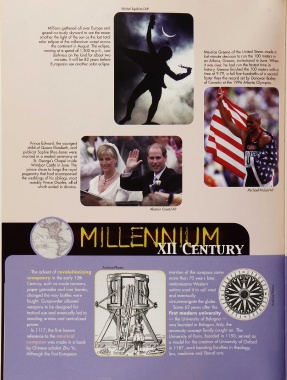
                Prince  Edward,  the youngest
               child  of Queen  Elizabeth,  and
            publicist Sophie  Rhys-Jones were
            married  in  a  modest ceremony at
                 St.  George's  Chapel  inside
                W indsor Castle  in  June.  The
              prince  chose  to  forgo  the  royal
            pageantry that had  accompanied
            the weddings of his  siblings,  most
                notably  Prince Charles,  all  of
                   which  ended  in  divorce.
                                                                                                                          Michael  Probst/AP


                                                                          Alastair G rant/AP


                The advent of revolutionizing
              weaponry in  the early  12th
              Century,  such  as  crude cannons,
              paper grenades and  iron  bombs,
              changed  the way battles were
              fought.  Gunpowder allowed
              weapons  to be  designed  for
              tactical  use and  eventually led  to
              standing  armies and  centralized
              power.
                In  1117,  the first known
              reference to the nautical
              compass  was  made  in  a  book
              by Chinese  scholar Zhu  Yu.
              Although  the  first European

