


Page 117 - 1983
P. 117
Cell-mates
ne and a half years of
O science were required, but
many students took between
two and four years of natural
sciences.
Students with heavy class
loads were often found taking
modular science, a class that
applied science to everyday
needs.
Modern biology gave students
a general knowledge of the
interrelationships among living
things in their environment.
Two consecutive periods were
allotted for chemistry, a class
helpful to the college-bound —.
student.
Physics aimed at students
interested in matter and energy.
Many science students were
to be seen struggling with
formulas, discussing the
dissection of cats, and
complaining about the length of
double-block classes.
Considering that one needed
more p.e. than science credits, it
was gratifying to many science
teachers to see students
applying themselves to advanced
courses such as zoology and
physiology.
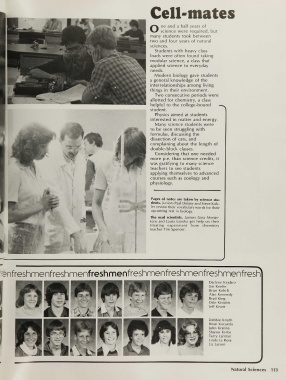
Pages of notes are taken by science stu
dents. Juniors Paul Dulany and Steve Koh
ler review their vocabulary words for their
upcoming test in biology.
The mad scientists. Juniors Gina Monas-
tero and Laura Lanoha get help on their
titrating experim ent from chem istry
teacher Tim Spencer.
?nfreshmenfreshmenfreshmenfreshmenfreshmenfreshmenfresh
Darlene Kajdacz
Jim Keeffe
Brian Kehrli
Alan Kennedy
Brad King
Dale Kistaitis
Jeff Knott
Debbie Knuth
Brian Kocanda
John Kratina
Sharon Krebs
Terry Larimer
Linda La Rosa
Liz Larson
J
Natural Sciences 113

