


Page 65 - Straight Talk On Project Management IV
P. 65
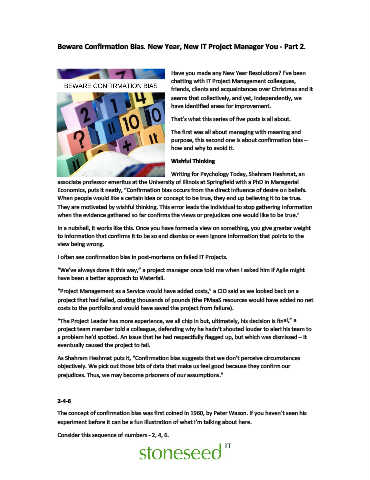
Beware Confirmation Bias. New Year, New IT Project Manager You - Part 2.


                                                       Have you made any New Year Resolutions? I’ve been
                                                       chatting with IT Project Management colleagues,
                                                       friends, clients and acquaintances over Christmas and it
                                                       seems that collectively, and yet, independently, we
                                                       have identified areas for improvement.

                                                       That’s what this series of five posts is all about.
                                                       The first was all about managing with meaning and
                                                       purpose, this second one is about confirmation bias –
                                                       how and why to avoid it.

                                                       Wishful Thinking

                                                       Writing for Psychology Today, Shahram Heshmat, an
               associate professor emeritus at the University of Illinois at Springfield with a PhD in Managerial
               Economics, puts it neatly, “Confirmation bias occurs from the direct influence of desire on beliefs.
               When people would like a certain idea or concept to be true, they end up believing it to be true.
               They are motivated by wishful thinking. This error leads the individual to stop gathering information
               when the evidence gathered so far confirms the views or prejudices one would like to be true.”
               In a nutshell, it works like this. Once you have formed a view on something, you give greater weight
               to information that confirms it to be so and dismiss or even ignore information that points to the
               view being wrong.

               I often see confirmation bias in post-mortems on failed IT Projects.

               “We’ve always done it this way,” a project manager once told me when I asked him if Agile might
               have been a better approach to Waterfall.

               “Project Management as a Service would have added costs,” a CIO said as we looked back on a
               project that had failed, costing thousands of pounds (the PMaaS resources would have added no net
               costs to the portfolio and would have saved the project from failure).

               “The Project Leader has more experience, we all chip in but, ultimately, his decision is final,” a
               project team member told a colleague, defending why he hadn’t shouted louder to alert his team to
               a problem he’d spotted. An issue that he had respectfully flagged up, but which was dismissed – it
               eventually caused the project to fail.

               As Shahram Heshmat puts it, “Confirmation bias suggests that we don’t perceive circumstances
               objectively. We pick out those bits of data that make us feel good because they confirm our
               prejudices. Thus, we may become prisoners of our assumptions.”


               2-4-6

               The concept of confirmation bias was first coined in 1960, by Peter Wason. If you haven’t seen his
               experiment before it can be a fun illustration of what I’m talking about here.

               Consider this sequence of numbers - 2, 4, 6.

