


Page 87 - pd296-August21-mag-web
P. 87
“It’s not just about Aboriginal people
                                                                                 having a  seat  at  the table,  it’s  actually
                                                                                 placing weight and value on what Abo-
                                                                                 riginal people say to make decisions.
                                                                                 That’s really, really important and I urge
                                                                                 everyone to consider  employing more
                                                                                 Aboriginal people when developing a
                                                                                 business strategy because that’s where
                                                                                 we’ll have effective change that is inte-
                                                                                 grated into our business in the future. I
                                                                                 feel very lucky to be able to work at BHP
                                                                                 in a strategic role where I  can do this,
                                                                                 and so I urge every other company to do
                                                                                 that as well.”
                                                                                   Davenport also urged companies to
                                                                                 seek  out  Aboriginal businesses rather
                                                                                 than the other way around.
                                                                                   “All too often when I’m sitting and talk-
                                                                                 ing with Aboriginal business they say:
                                                                                 ‘we just don’t know who to talk to’ and the
                                                                                 bigger the organisation, the harder it is
                                                                                 to get access, so you need to go to them
                                                                                 and make them  aware of  what  the op-
                                                                                 portunity is and what the process is for
                                                                                 being part of the supply chain,” she said.
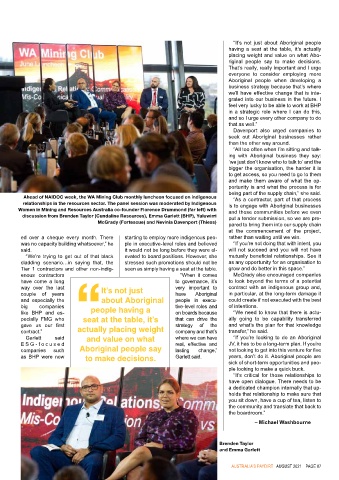
         Ahead of NAIDoC week, the WA Mining Club monthly luncheon focused on indigenous   “As a contractor, part of that process
         relationships in the resources sector. The panel session was moderated by Indigenous   is to engage with Aboriginal businesses
       Women in Mining and Resources Australia co-founder Florence Drummond (far left) with   and those communities before we even
         discussion from Brenden Taylor (Cundaline Resources), Emma Garlett (BHP), Yuluwirri   put a tender submission, so we are pre-
                                   McGrady (Fortescue) and Nevinia Davenport (Thiess)
                                                                                 pared to bring them into our supply chain
                                                                                 at the commencement  of the project,
        ed over a cheque  every month.  There   starting to employ more indigenous peo-  rather than waiting until we win.
        was no capacity building whatsoever,” he   ple in executive-level roles and believed   “If you’re not doing that with intent, you
        said.                                it would not be long before they were el-  will not  succeed and you will not  have
          “We’re trying to get out of that black   evated to board positions. However, she   mutually  beneficial  relationships.  See  it
        cladding scenario…in saying that, the   stressed such promotions should not be   as any opportunity for an organisation to
        Tier  1  contractors  and  other  non-indig-  seen as simply having a seat at the table.  grow and do better in this space.”
        enous contractors                                       “When it comes     McGrady also encouraged companies
        have come a long                                       to governance, it’s   to look beyond the terms of a potential
        way over the last                                      very  important  to   contract with an indigenous group and,
        couple of years              It’s not just             have   Aboriginal  in particular, at the long-term damage it
        and especially the  “        about Aboriginal          people  in  execu-  could create if not executed with the best
        big    companies                                       tive-level roles and   of intentions.
        like  BHP  and  es-      people having a               on boards because   “We need to know that there is actu-
        pecially FMG who      seat at the table, it’s          that can drive the   ally going to be capability transferred
        gave  us  our  first                                   strategy  of  the  and what’s the plan for that knowledge
        contract.”          actually placing weight            company and that’s   transfer,” he said.
          Garlett   said       and value on what               where we can have   “If you’re looking to do an Aboriginal
        E S G -f o cu s e d                                    real, effective and   JV, it has to be a long-term plan. If you’re
        companies   such     Aboriginal people say             lasting  change,”  not looking to get into this venture for five
        as BHP were now        to make decisions.              Garlett said.     years, don’t do it. Aboriginal people are
                                                                                 sick of short-term opportunities and peo-
                                                                                 ple looking to make a quick buck.
                                                                                   “It’s critical for those relationships to
                                                                                 have open dialogue. There needs to be
                                                                                 a dedicated champion internally that up-
                                                                                 holds that relationship to make sure that
                                                                                 you sit down, have a cup of tea, listen to
                                                                                 the community and translate that back to
                                                                                 the boardroom.”
                                                                                             – Michael Washbourne


                                                                              Brenden Taylor
                                                                              and Emma Garlett


                                                                                  aUSTRaLIa’S PaYDIRT   aUgUST 2021    Page 87

