


Page 528 - First Aid for the USMLE Step 1 2020, Thirtieth edition [MedicalBooksVN.com]_Neat
P. 528
484 section iii Musculoskeletal, skin, and connective tissue ` dERmatology Musculoskeletal, skin, and connective tissue ` phaRmaCology
Skin cancer Basal cell carcinoma more common above upper lip
Squamous cell carcinoma more common below lower lip
Sun exposure strongly predisposes to skin cancer.
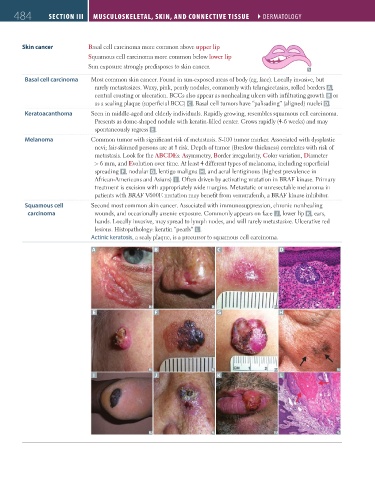
Basal cell carcinoma Most common skin cancer. Found in sun-exposed areas of body (eg, face). Locally invasive, but
rarely metastasizes. Waxy, pink, pearly nodules, commonly with telangiectasias, rolled borders A ,
central crusting or ulceration. BCCs also appear as nonhealing ulcers with infiltrating growth B or
as a scaling plaque (superficial BCC) C . Basal cell tumors have “palisading” (aligned) nuclei D.
Keratoacanthoma Seen in middle-aged and elderly individuals. Rapidly growing, resembles squamous cell carcinoma.
Presents as dome-shaped nodule with keratin-filled center. Grows rapidly (4-6 weeks) and may
spontaneously regress E .
Melanoma Common tumor with significant risk of metastasis. S-100 tumor marker. Associated with dysplastic
nevi; fair-skinned persons are at risk. Depth of tumor (Breslow thickness) correlates with risk of
metastasis. Look for the ABCDEs: Asymmetry, Border irregularity, Color variation, Diameter
> 6 mm, and Evolution over time. At least 4 different types of melanoma, including superficial
spreading F , nodular G, lentigo maligna H, and acral lentiginous (highest prevalence in
African-Americans and Asians) I . Often driven by activating mutation in BRAF kinase. Primary
treatment is excision with appropriately wide margins. Metastatic or unresectable melanoma in
patients with BRAF V600E mutation may benefit from vemurafenib, a BRAF kinase inhibitor.
Squamous cell Second most common skin cancer. Associated with immunosuppression, chronic nonhealing
carcinoma wounds, and occasionally arsenic exposure. Commonly appears on face J , lower lip K , ears,
hands. Locally invasive, may spread to lymph nodes, and will rarely metastasize. Ulcerative red
lesions. Histopathology: keratin “pearls” L .
Actinic keratosis, a scaly plaque, is a precursor to squamous cell carcinoma.
A B C D
E F G H
I J K L
FAS1_2019_11-Musculo.indd 484 11/7/19 5:24 PM

