


Page 30 - ATR 6 2013 digital
P. 30
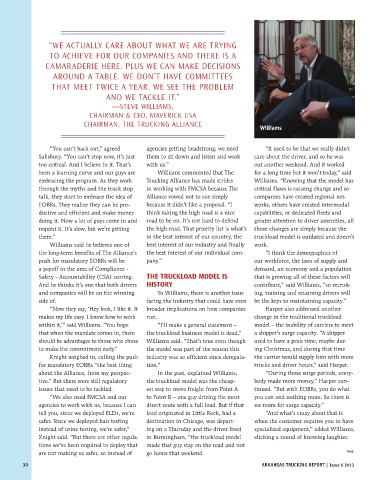
“we acTually care abouT whaT we are TryiNg
To achieVe for our compaNies aNd There is a
camaraderie here. plus we caN make decisioNs
arouNd a Table. we doN’T haVe commiTTees
ThaT meeT Twice a year. we see The problem
aNd we Tackle iT.”
—sTeVe williams,
chairmaN & ceo, maVerick usa
chairmaN, The TruckiNg alliaNce
Williams
“You can’t back out,” agreed agencies getting headstrong, we need “It used to be that we really didn’t
Salisbury. “You can’t stop now, it’s just them to sit down and listen and work care about the driver, and so he was
too critical. And I believe in it. That’s with us.” out another weekend. And it worked
been a learning curve and our guys are Williams commented that The for a long time but it won’t today,” said
embracing the program. As they work Trucking Alliance has made strides Williams. “Knowing that the model has
through the myths and the truck stop in working with FMCSA because The critical flaws is causing change and so
talk, they start to embrace the idea of Alliance vowed not to sue simply companies have created regional net-
EOBRs. They realize they can be pro- because it didn’t like a proposal. “I works, others have created intermodal
ductive and efficient and make money think taking the high road is a nice capabilities, or dedicated fleets and
doing it. Now a lot of guys come in and road to be on. It’s not hard to defend greater attention to driver amenities, all
request it. It’s slow, but we’re getting the high road. That priority list is what’s those changes are simply because the
there.” in the best interest of our country, the truckload model is outdated and doesn’t
Williams said he believes one of best interest of our industry and finally work.
the long-term benefits of The Alliance’s the best interest of our individual com- “I think the demographics of
push for mandatory EOBRs will be pany.” our workforce, the laws of supply and
a payoff in the area of Compliance - demand, an economy and a population
Safety - Accountability (CSA) scoring. thE trUckload ModEl is that is growing all of these factors will
And he thinks it’s one that both drivers history contribute,” said Williams, “so recruit-
and companies will be on the winning To Williams, there is another issue ing, training and retaining drivers will
side of. facing the industry that could have even be the keys to maintaining capacity.”
“Now they say, ‘Hey look, I like it. It broader implications on how companies Harper also addressed another
makes my life easy. I know how to work run. change in the traditional truckload
within it,’” said Williams. “You hope “I’ll make a general statement – model – the inability of carriers to meet
that when the mandate comes in, there the truckload business model is dead,” a shipper’s surge capacity. “A shipper
should be advantages to those who chose Williams said. “That’s true even though used to have a peak time, maybe dur-
to make the commitment early.” the model was part of the reason this ing Christmas, and during that time
Knight weighed in, calling the push industry was so efficient since deregula- the carrier would supply him with more
for mandatory EOBRs “the best thing tion.” trucks and driver hours,” said Harper.
about the Alliance, from my perspec- In the past, explained Williams, “During those surge periods, every-
tive.” But there were still regulatory the truckload model was the cheap- body made more money,” Harper con-
issues that need to be tackled. est way to move freight from Point A tinued. “But with EOBRs, you do what
“We also need FMCSA and our to Point B – one guy driving the most you can and nothing more. So there is
agencies to work with us, because I can direct route with a full load. But if that no room for surge capacity.”
tell you, since we deployed ELDs, we’re load originated in Little Rock, had a “And what’s crazy about that is
safer. Since we deployed hair testing destination in Chicago, was depart- when the customer requires you to have
instead of urine testing, we’re safer,” ing on a Thursday and the driver lived specialized equipment,” added Williams,
Knight said. “But there are other regula- in Birmingham, “the truckload model eliciting a round of knowing laughter.
tions we’ve been required to deploy that made that guy stay on the road and not
are not making us safer, so instead of go home that weekend.
30 arkaNsas TruckiNg reporT | issue 6 2013

