


Page 37 - ATR 5 2014 web
P. 37
Charitable logistics


        The distribution operations of Arkansas charity


                 by bethany may

                   Managing Editor

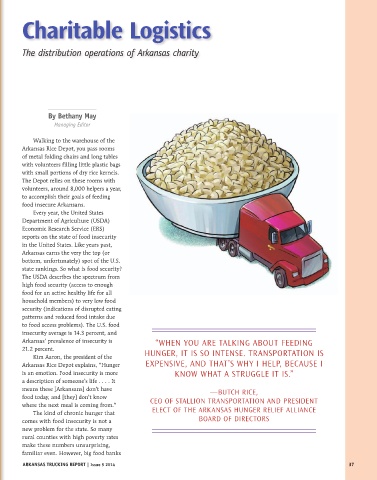
            Walking to the warehouse of the
        Arkansas Rice Depot, you pass rooms
        of metal folding chairs and long tables
        with volunteers filling little plastic bags
        with small portions of dry rice kernels.
        The Depot relies on these rooms with
        volunteers, around 8,000 helpers a year,
        to accomplish their goals of feeding
        food insecure Arkansans.
            Every year, the United States
        Department of Agriculture (USDA)
        Economic Research Service (ERS)
        reports on the state of food insecurity
        in the United States. Like years past,
        Arkansas earns the very the top (or
        bottom, unfortunately) spot of the U.S.
        state rankings. So what is food security?
        The USDA describes the spectrum from
        high food security (access to enough
        food for an active healthy life for all
        household members) to very low food
        security (indications of disrupted eating
        patterns and reduced food intake due
        to food access problems). The U.S. food
        insecurity average is 14.3 percent, and
        Arkansas’ prevalence of insecurity is      “wheN you are talkiNg about feediNg
        21.2 percent.
            Kim Aaron, the president of the     huNger, it is so iNteNse. traNsPortatioN is
        Arkansas Rice Depot explains, “Hunger   exPeNsiVe, aNd that’s why i helP, because i
        is an emotion. Food insecurity is more            kNow what a struggle it is.”
        a description of someone’s life . . . . It
        means these [Arkansans] don’t have                           —butch rice,
        food today, and [they] don’t know
        where the next meal is coming from.”      ceo of stallioN traNsPortatioN aNd PresideNt
            The kind of chronic hunger that       elect of the arkaNsas huNger relief alliaNce
        comes with food insecurity is not a                       board of directors
        new problem for the state. So many
        rural counties with high poverty rates
        make these numbers unsurprising,
        familiar even. However, big food banks

        aRkansas tRuCking RepoRt | issue 5 2014                                                                   37

