


Page 119 - The City and Guilds Textbook: Plumbing Book 1 for the Level 3 Apprenticeship (9189), Level 2 Technical Certificate (8202) and Level 2 Diploma (6035)
P. 119
Chapter 2 Common processes and techniques


                4  Take the pipe from the machine and place a straight edge against the
                   back of the pipe. Mark the measurement of the second bend at point B
                   (Figure 2.28).                                                                INDUSTRY TIP
                5  Put the pipe back into the machine and line the mark up with the centre of   With the off-set bend, you
                   the former.                                                              may find it easier to make a
                6  Bend the second bend and check with the template.                        welding rod template bent to

                                                                                            the required angle (say 45°).
                Jointing low carbon steel pipe                                              This can be used for both
                There are three ways to joint low carbon steel pipe. These are:             the first and second bends.
                                                                                            Remember to over-bend
                1  threaded joints                                                          both bends by 5° to allow for
                2  compression joints                                                       spring back.
                3  welded joints.

                We will look at the first two only, as welded joints are generally used only on
                larger pipes in industrial applications and installations.

                Threaded joints

                Low carbon steel pipes can be jointed using threads to BS 21, which are
                cut into the end of the pipes using either manual stocks and dies or electric
                threading machines (see page 88 of this chapter). There are two kinds of
                thread, as follows.

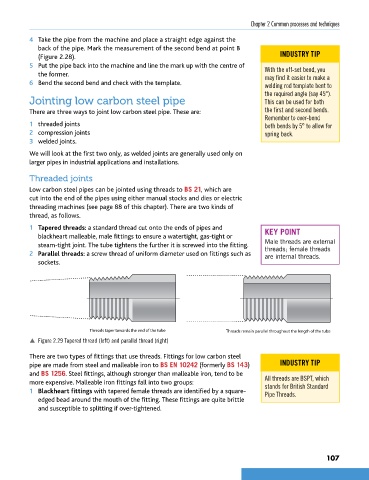
                1  Tapered threads: a standard thread cut onto the ends of pipes and        KEY POINT
                   blackheart malleable, male fittings to ensure a watertight, gas-tight or
                   steam-tight joint. The tube tightens the further it is screwed into the fitting.  Male threads are external
                2  Parallel threads: a screw thread of uniform diameter used on fittings such as   threads; female threads
                                                                                            are internal threads.
                   sockets.


                                   Threads taper towards the end of the tube    Threads remain parallel throughout the length of the tube
                p  Figure 2.29 Tapered thread (left) and parallel thread (right)


                There are two types of fittings that use threads. Fittings for low carbon steel
                pipe are made from steel and malleable iron to BS EN 10242 (formerly BS 143)     INDUSTRY TIP
                and BS 1256. Steel fittings, although stronger than malleable iron, tend to be
                more expensive. Malleable iron fittings fall into two groups:               All threads are BSPT, which
                                                                                            stands for British Standard
                1  Blackheart fittings with tapered female threads are identified by a square-  Pipe Threads.
                   edged bead around the mouth of the fitting. These fittings are quite brittle
                   and susceptible to splitting if over-tightened.


                                                                                                                107


        9781510416482.indb   107                                                                                    29/03/19   8:53 PM

