


Page 123 - The City and Guilds Textbook: Plumbing Book 1 for the Level 3 Apprenticeship (9189), Level 2 Technical Certificate (8202) and Level 2 Diploma (6035)
P. 123
Chapter 2 Common processes and techniques

                Fusion welded
                Large underground water mains use fusion-welded fittings, where the fitting and   INDUSTRY TIP
                the pipe are welded together by heat created by electricity. A special fitting is   When PB-1 pipe was first
                used that has an electrical element inside the fitting body, which when subjected   introduced in the late 1980s,
                to electricity, generates heat, which melts the fitting and the pipe together.  central heating systems
                                                                                            suffered failure due to
                Polybutylene (PB-1)                                                         increased black oxide sludge

                Polybutylene is the latest plastic to be manufactured into pipe for pressurised   created by excess air in the
                plumbing systems. Polybutylene is very flexible, allowing it to be cabled easily and   system. This has since been
                quickly through timber joists during the installation process. It has a high   cured with the introduction
                temperature and pressure resistance, low noise transmission, low thermal    of barrier pipe, which has an
                expansion and low thermal transmission. Its internal bore is very smooth, giving it   impermeable barrier placed in
                good flow rate characteristics and it does not suffer from corrosion or scaling. It is,   the walls of the pipe. Barrier
                                                                                            pipe is not needed for hot and
                however, micro-porous, allowing air to be leeched through the walls of the pipe.
                                                                                            cold water installations.
                Polybutylene pipe is usually coloured white or grey, but older PB pipe (known as
                Acorn) is usually coloured brown. It can be used on hot and cold water
                installations, wet central heating systems and underfloor heating. It is
                available in sizes 10 mm, 15 mm, 22 mm and 28 mm, in straight lengths
                of 3 m, and coils of 25 m, 50 m and 100 m lengths. The pipe sizes are
                compatible with copper tubes to BS EN 1057.

                The benefits of using polybutylene pipe
                In recent years, polybutylene pipe has become very popular with both
                installers and architects for new-build installations. There are many
                reasons for this:
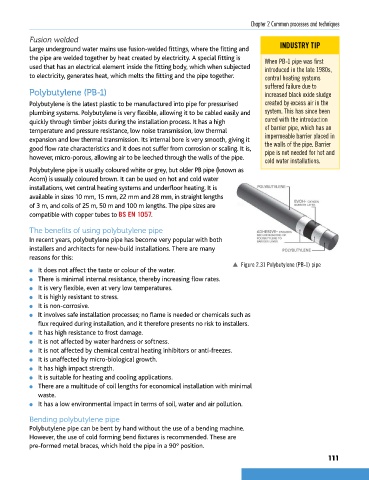
                                                                                  p  Figure 2.31 Polybutylene (PB-1) pipe
                ●  It does not affect the taste or colour of the water.
                ●  There is minimal internal resistance, thereby increasing flow rates.
                ●  It is very flexible, even at very low temperatures.
                ●  It is highly resistant to stress.
                ●  It is non-corrosive.
                ●  It involves safe installation processes; no flame is needed or chemicals such as
                   flux required during installation, and it therefore presents no risk to installers.
                ●  It has high resistance to frost damage.
                ●  It is not affected by water hardness or softness.
                ●  It is not affected by chemical central heating inhibitors or anti-freezes.
                ●  It is unaffected by micro-biological growth.
                ●  It has high impact strength.
                ●  It is suitable for heating and cooling applications.
                ●  There are a multitude of coil lengths for economical installation with minimal
                   waste.
                ●  It has a low environmental impact in terms of soil, water and air pollution.

                Bending polybutylene pipe
                Polybutylene pipe can be bent by hand without the use of a bending machine.
                However, the use of cold forming bend fixtures is recommended. These are
                pre-formed metal braces, which hold the pipe in a 90° position.
                                                                                                                111


        9781510416482.indb   111                                                                                    29/03/19   8:53 PM

