


Page 20 - The City and Guilds Textbook: Plumbing Book 1 for the Level 3 Apprenticeship (9189), Level 2 Technical Certificate (8202) and Level 2 Diploma (6035)
P. 20
The City & Guilds Textbook: Plumbing Book 1

                                            The Regulations also include requirements for existing places of work and means
                                            of access for working at height, collective fall prevention equipment such as
                                            guardrails and working platforms, collective fall arresters such as nets and airbags,
                                            personal fall protection such as harnesses and work restraints, and ladders.

                                            The Manual Handling Operations Regulations 1992
                                            The Manual Handling Operations Regulations apply to a wide range of manual
                                            handling activities, including lifting, lowering, pushing, pulling and carrying. In
                                            the Regulations, loads are described as being either inanimate – for example, a
                                            gas boiler – or animate, such as a person or animal.
                                            The Regulations require employers to:

                                            ●  avoid hazardous manual handling operations so far as is reasonably practicable
                                            ●  assess any hazardous manual handling operations that cannot be avoided
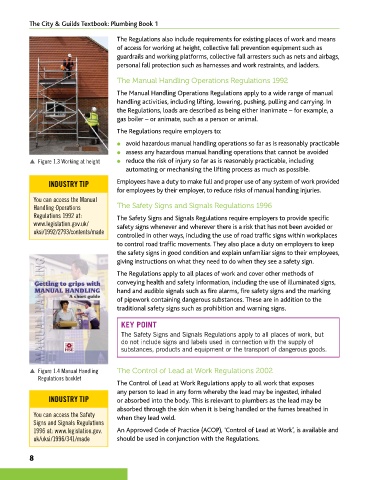
                p  Figure 1.3 Working at height  ●  reduce the risk of injury so far as is reasonably practicable, including
                                               automating or mechanising the lifting process as much as possible.

                      INDUSTRY TIP          Employees have a duty to make full and proper use of any system of work provided
                                            for employees by their employer, to reduce risks of manual handling injuries.
                 You can access the Manual
                 Handling Operations        The Safety Signs and Signals Regulations 1996
                 Regulations 1992 at:       The Safety Signs and Signals Regulations require employers to provide specific
                 www.legislation.gov.uk/    safety signs whenever and wherever there is a risk that has not been avoided or
                 uksi/1992/2793/contents/made
                                            controlled in other ways, including the use of road traffic signs within workplaces
                                            to control road traffic movements. They also place a duty on employers to keep
                                            the safety signs in good condition and explain unfamiliar signs to their employees,
                                            giving instructions on what they need to do when they see a safety sign.

                                            The Regulations apply to all places of work and cover other methods of
                                            conveying health and safety information, including the use of illuminated signs,
                                            hand and audible signals such as fire alarms, fire safety signs and the marking
                                            of pipework containing dangerous substances. These are in addition to the
                                            traditional safety signs such as prohibition and warning signs.

                                              KEY POINT
                                              The Safety Signs and Signals Regulations apply to all places of work, but
                                              do not include signs and labels used in connection with the supply of
                                              substances, products and equipment or the transport of dangerous goods.


                p  Figure 1.4 Manual Handling   The Control of Lead at Work Regulations 2002
                   Regulations booklet
                                            The Control of Lead at Work Regulations apply to all work that exposes
                                            any person to lead in any form whereby the lead may be ingested, inhaled
                      INDUSTRY TIP          or absorbed into the body. This is relevant to plumbers as the lead may be
                                            absorbed through the skin when it is being handled or the fumes breathed in
                 You can access the Safety   when they lead weld.
                 Signs and Signals Regulations
                 1996 at: www.legislation.gov.  An Approved Code of Practice (ACOP), ‘Control of Lead at Work’, is available and
                 uk/uksi/1996/341/made      should be used in conjunction with the Regulations.


                8


        9781510416482.indb   8                                                                                      29/03/19   8:48 PM

