


Page 261 - The City and Guilds Textbook: Plumbing Book 1 for the Level 3 Apprenticeship (9189), Level 2 Technical Certificate (8202) and Level 2 Diploma (6035)
P. 261
Chapter 5 Cold water systems
Sedimentation, filtration, sterilisation
and aeration of water
Before it is considered wholesome, the water undergoes several stages
of treatment to ensure its cleanliness and quality. These stages are the
responsibility of the water undertaker and are known as:
● sedimentation
● filtration
● sterilisation
● aeration.
Sedimentation KEY TERM
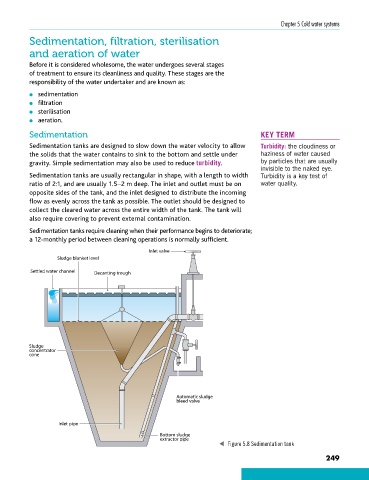
Sedimentation tanks are designed to slow down the water velocity to allow Turbidity: the cloudiness or
the solids that the water contains to sink to the bottom and settle under haziness of water caused
gravity. Simple sedimentation may also be used to reduce turbidity. by particles that are usually
invisible to the naked eye.
Sedimentation tanks are usually rectangular in shape, with a length to width Turbidity is a key test of
ratio of 2:1, and are usually 1.5–2 m deep. The inlet and outlet must be on water quality.
opposite sides of the tank, and the inlet designed to distribute the incoming
flow as evenly across the tank as possible. The outlet should be designed to
collect the cleared water across the entire width of the tank. The tank will
also require covering to prevent external contamination.
Sedimentation tanks require cleaning when their performance begins to deteriorate;
a 12-monthly period between cleaning operations is normally sufficient.
Inlet valve
Sludge blanket level
Settled water channel Decanting trough
Sludge
concentrator
cone
Automatic sludge
bleed valve
Inlet pipe
Bottom sludge
extractor pipe
Figure 5.8 Sedimentation tank
249
9781510416482.indb 249 29/03/19 8:57 PM

