


Page 262 - The City and Guilds Textbook: Plumbing Book 1 for the Level 3 Apprenticeship (9189), Level 2 Technical Certificate (8202) and Level 2 Diploma (6035)
P. 262
The City & Guilds Textbook: Plumbing Book 1

                                            Filtration

                                            Filtration is an important process that removes turbidity and algae from the
                                            raw, untreated water. There are many different types of filter, including screens,
                                            gravel filters, slow sand filters, rapid sand filters and pressure filters. We will
                                            concentrate on three of these:

                                            1  slow sand filters
                                            2  rapid sand filters
                                            3  pressure filters.

                                            The difference between these types is not just a matter of the speed of the
                                            filtration process, but the underlying principle of the method. Slow sand filtration
                                            is a biological process and rapid sand filtration is a physical treatment process.

                                            Slow sand filters
                                            These are often preceded by micro-straining or coarse filtration. These filters
                                            are used primarily to remove micro-organisms, algae and turbidity. It is a slow
                                            but very reliable method of water treatment, often suited to small supplies,
                                            provided that there is sufficient area to properly construct the filtration tanks.
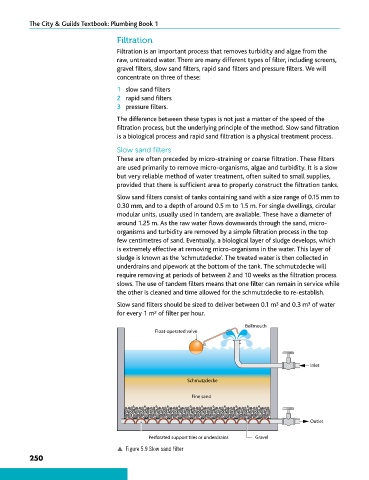
                                            Slow sand filters consist of tanks containing sand with a size range of 0.15 mm to
                                            0.30 mm, and to a depth of around 0.5 m to 1.5 m. For single dwellings, circular
                                            modular units, usually used in tandem, are available. These have a diameter of
                                            around 1.25 m. As the raw water flows downwards through the sand, micro-
                                            organisms and turbidity are removed by a simple filtration process in the top
                                            few centimetres of sand. Eventually, a biological layer of sludge develops, which
                                            is extremely effective at removing micro-organisms in the water. This layer of
                                            sludge is known as the ‘schmutzdecke’. The treated water is then collected in
                                            underdrains and pipework at the bottom of the tank. The schmutzdecke will
                                            require removing at periods of between 2 and 10 weeks as the filtration process
                                            slows. The use of tandem filters means that one filter can remain in service while
                                            the other is cleaned and time allowed for the schmutzdecke to re-establish.
                                            Slow sand filters should be sized to deliver between 0.1 m  and 0.3 m  of water
                                                                                                3
                                                                                                          3
                                            for every 1 m  of filter per hour.
                                                        2
                                                                                      Bellmouth
                                                         Float-operated valve


                                                                                                           Inlet

                                                                   Schmutzdecke

                                                                    Fine sand


                                                                                                           Outlet

                                                      Perforated support tiles or underdrains  Gravel
                                            p  Figure 5.9 Slow sand filter
                250


        9781510416482.indb   250                                                                                    29/03/19   8:57 PM

