


Page 372 - The City and Guilds Textbook: Plumbing Book 1 for the Level 3 Apprenticeship (9189), Level 2 Technical Certificate (8202) and Level 2 Diploma (6035)
P. 372
The City & Guilds Textbook: Plumbing Book 1
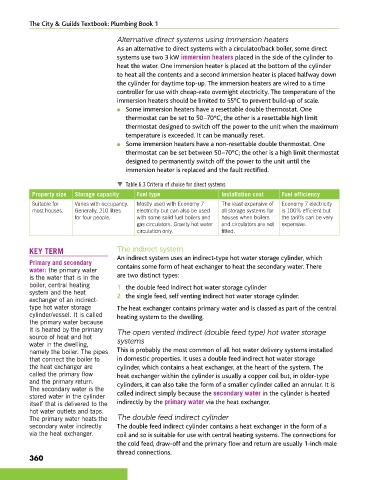
Alternative direct systems using immersion heaters
As an alternative to direct systems with a circulator/back boiler, some direct
systems use two 3 kW immersion heaters placed in the side of the cylinder to
heat the water. One immersion heater is placed at the bottom of the cylinder
to heat all the contents and a second immersion heater is placed halfway down
the cylinder for daytime top-up. The immersion heaters are wired to a time
controller for use with cheap-rate overnight electricity. The temperature of the
immersion heaters should be limited to 55°C to prevent build-up of scale.
● Some immersion heaters have a resettable double thermostat. One
thermostat can be set to 50–70°C, the other is a resettable high limit
thermostat designed to switch off the power to the unit when the maximum
temperature is exceeded. It can be manually reset.
● Some immersion heaters have a non-resettable double thermostat. One
thermostat can be set between 50–70°C; the other is a high limit thermostat
designed to permanently switch off the power to the unit until the
immersion heater is replaced and the fault rectified.
Table 6.3 Criteria of choice for direct systems
Property size Storage capacity Fuel type Installation cost Fuel efficiency
Suitable for Varies with occupancy. Mostly used with Economy 7 The least expensive of Economy 7 electricity
most houses. Generally, 210 litres electricity but can also be used all storage systems for is 100% efficient but
for four people. with some solid fuel boilers and houses when boilers the tariffs can be very
gas circulators. Gravity hot water and circulators are not expensive.
circulation only. fitted.
KEY TERM The indirect system
An indirect system uses an indirect-type hot water storage cylinder, which
Primary and secondary contains some form of heat exchanger to heat the secondary water. There
water: the primary water
is the water that is in the are two distinct types:
boiler, central heating 1 the double feed indirect hot water storage cylinder
system and the heat 2 the single feed, self venting indirect hot water storage cylinder.
exchanger of an indirect-
type hot water storage The heat exchanger contains primary water and is classed as part of the central
cylinder/vessel. It is called heating system to the dwelling.
the primary water because
it is heated by the primary The open vented indirect (double feed type) hot water storage
source of heat and hot
water in the dwelling, systems
namely the boiler. The pipes This is probably the most common of all hot water delivery systems installed
that connect the boiler to in domestic properties. It uses a double feed indirect hot water storage
the heat exchanger are cylinder, which contains a heat exchanger, at the heart of the system. The
called the primary flow heat exchanger within the cylinder is usually a copper coil but, in older-type
and the primary return. cylinders, it can also take the form of a smaller cylinder called an annular. It is
The secondary water is the
stored water in the cylinder called indirect simply because the secondary water in the cylinder is heated
itself that is delivered to the indirectly by the primary water via the heat exchanger.
hot water outlets and taps.
The primary water heats the The double feed indirect cylinder
secondary water indirectly The double feed indirect cylinder contains a heat exchanger in the form of a
via the heat exchanger. coil and so is suitable for use with central heating systems. The connections for
the cold feed, draw-off and the primary flow and return are usually 1-inch male
thread connections.
360
9781510416482.indb 360 29/03/19 9:01 PM

