


Page 376 - The City and Guilds Textbook: Plumbing Book 1 for the Level 3 Apprenticeship (9189), Level 2 Technical Certificate (8202) and Level 2 Diploma (6035)
P. 376
The City & Guilds Textbook: Plumbing Book 1


                                            heat pumps. The cylinder contains two heat exchanger coils. The first coil is
                                            used with a conventional fuel source such as gas or oil and this accounts for
                                            70 per cent of the cylinder’s hot water volume. The second coil has 30 per cent
                                            volume dedicated to the renewable energy heat source and is usually situated
                                            in the top third of the cylinder. They are suitable for:
                                            ●  modern fully pumped heating systems (see Chapter 7)
                                            ●  both vented and sealed heating systems up to 3.5 bar pressure.
                                            They are supplied with a double thickness of CFC-free polyurethane insulation
                                            and capacities from 130 litres to 300 litres.

                p  Figure 6.7 Double coil cylinder  Open vented indirect (single feed, self-venting type) hot water
                                            storage systems
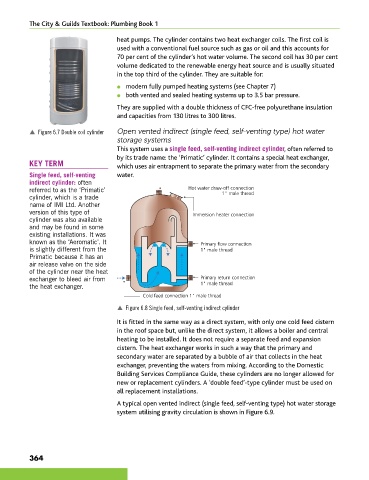
                                            This system uses a single feed, self-venting indirect cylinder, often referred to
                                            by its trade name: the ‘Primatic’ cylinder. It contains a special heat exchanger,
                KEY TERM                    which uses air entrapment to separate the primary water from the secondary

                Single feed, self-venting   water.
                indirect cylinder: often
                referred to as the ‘Primatic’                      Hot water draw-off connection
                cylinder, which is a trade                                    1" male thread
                name of IMI Ltd. Another
                version of this type of                              Immersion heater connection
                cylinder was also available
                and may be found in some
                existing installations. It was
                known as the ‘Aeromatic’. It                           Primary flow connection
                is slightly different from the                         1" male thread
                Primatic because it has an
                air release valve on the side
                of the cylinder near the heat
                exchanger to bleed air from                            Primary return connection
                the heat exchanger.                                    1" male thread
                                                     Cold feed connection 1" male thread

                                            p  Figure 6.8 Single feed, self-venting indirect cylinder

                                            It is fitted in the same way as a direct system, with only one cold feed cistern
                                            in the roof space but, unlike the direct system, it allows a boiler and central
                                            heating to be installed. It does not require a separate feed and expansion
                                            cistern. The heat exchanger works in such a way that the primary and
                                            secondary water are separated by a bubble of air that collects in the heat
                                            exchanger, preventing the waters from mixing. According to the Domestic
                                            Building Services Compliance Guide, these cylinders are no longer allowed for
                                            new or replacement cylinders. A ‘double feed’-type cylinder must be used on
                                            all replacement installations.
                                            A typical open vented indirect (single feed, self-venting type) hot water storage
                                            system utilising gravity circulation is shown in Figure 6.9.


                364


        9781510416482.indb   364                                                                                    29/03/19   9:01 PM

