


Page 389 - The City and Guilds Textbook: Plumbing Book 1 for the Level 3 Apprenticeship (9189), Level 2 Technical Certificate (8202) and Level 2 Diploma (6035)
P. 389
Chapter 6 Hot water systems


                                         Balanced cold   Isolation valve
                              Hot water draw-off water connection
                                                         In-line strainer

                                                         Pressure reducing valve


                Internal expansion                       Check valve
                pocket or air bubbles
                                                         Expansion (pressure)
                                                         relief valve
                        Flow                             Temperature relief valve
                Heat exchanger                           D1 discharge pipework
                Immersion heater                         Tundish
                                                         D2 discharge pipework
                       Return
                                                         Cold feed

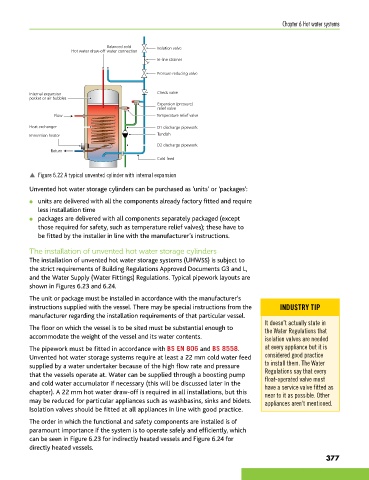
                p  Figure 6.22 A typical unvented cylinder with internal expansion

                Unvented hot water storage cylinders can be purchased as ‘units’ or ‘packages’:
                ●  units are delivered with all the components already factory fitted and require
                   less installation time
                ●  packages are delivered with all components separately packaged (except
                   those required for safety, such as temperature relief valves); these have to
                   be fitted by the installer in line with the manufacturer’s instructions.

                The installation of unvented hot water storage cylinders
                The installation of unvented hot water storage systems (UHWSS) is subject to
                the strict requirements of Building Regulations Approved Documents G3 and L,
                and the Water Supply (Water Fittings) Regulations. Typical pipework layouts are
                shown in Figures 6.23 and 6.24.

                The unit or package must be installed in accordance with the manufacturer’s
                instructions supplied with the vessel. There may be special instructions from the   INDUSTRY TIP
                manufacturer regarding the installation requirements of that particular vessel.
                                                                                            It doesn’t actually state in
                The floor on which the vessel is to be sited must be substantial enough to   the Water Regulations that
                accommodate the weight of the vessel and its water contents.                isolation valves are needed
                The pipework must be fitted in accordance with BS EN 806 and BS 8558.       at every appliance but it is
                Unvented hot water storage systems require at least a 22 mm cold water feed   considered good practice
                supplied by a water undertaker because of the high flow rate and pressure   to install them. The Water
                that the vessels operate at. Water can be supplied through a boosting pump   Regulations say that every
                                                                                            float-operated valve must
                and cold water accumulator if necessary (this will be discussed later in the   have a service valve fitted as
                chapter). A 22 mm hot water draw-off is required in all installations, but this   near to it as possible. Other
                may be reduced for particular appliances such as washbasins, sinks and bidets.   appliances aren’t mentioned.
                Isolation valves should be fitted at all appliances in line with good practice.

                The order in which the functional and safety components are installed is of
                paramount importance if the system is to operate safely and efficiently, which
                can be seen in Figure 6.23 for indirectly heated vessels and Figure 6.24 for
                directly heated vessels.
                                                                                                                377


        9781510416482.indb   377                                                                                    29/03/19   9:01 PM

