


Page 396 - The City and Guilds Textbook: Plumbing Book 1 for the Level 3 Apprenticeship (9189), Level 2 Technical Certificate (8202) and Level 2 Diploma (6035)
P. 396
The City & Guilds Textbook: Plumbing Book 1


                                            Inside the unit are two heat exchangers, which the mains cold water passes
                                            through, and a small expansion chamber. The expansion chamber allows for
                                            the small amount of expansion of the secondary water. The primary water can
                                            reach temperatures of up to 82°C, which can, potentially, be transferred into
                                            the secondary water. Because of this, an adjustable thermostatic mixing valve
                                            blends the secondary hot water with mains cold water so that the water does
                                            not exceed 60°C.

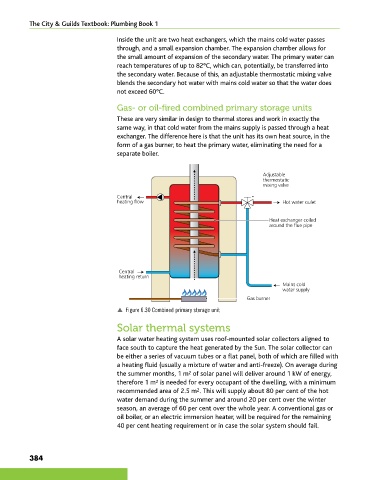
                                            Gas- or oil-fired combined primary storage units

                                            These are very similar in design to thermal stores and work in exactly the
                                            same way, in that cold water from the mains supply is passed through a heat
                                            exchanger. The difference here is that the unit has its own heat source, in the
                                            form of a gas burner, to heat the primary water, eliminating the need for a
                                            separate boiler.


                                                                                           Adjustable
                                                                                           thermostatic
                                                                                           mixing valve
                                            Central
                                            heating flow                                          Hot water oulet

                                                                                              Heat exchanger coiled
                                                                                              around the flue pipe


                                             Central
                                             heating return
                                                                                                  Mains cold
                                                                                                  water supply
                                                                                      Gas burner
                                            p  Figure 6.30 Combined primary storage unit

                                            Solar thermal systems

                                            A solar water heating system uses roof-mounted solar collectors aligned to
                                            face south to capture the heat generated by the Sun. The solar collector can
                                            be either a series of vacuum tubes or a flat panel, both of which are filled with
                                            a heating fluid (usually a mixture of water and anti-freeze). On average during
                                                                   2
                                            the summer months, 1 m  of solar panel will deliver around 1 kW of energy,
                                            therefore 1 m  is needed for every occupant of the dwelling, with a minimum
                                                         2
                                            recommended area of 2.5 m . This will supply about 80 per cent of the hot
                                                                      2
                                            water demand during the summer and around 20 per cent over the winter
                                            season, an average of 60 per cent over the whole year. A conventional gas or
                                            oil boiler, or an electric immersion heater, will be required for the remaining
                                            40 per cent heating requirement or in case the solar system should fail.


                384


        9781510416482.indb   384                                                                                    29/03/19   9:01 PM

