


Page 399 - The City and Guilds Textbook: Plumbing Book 1 for the Level 3 Apprenticeship (9189), Level 2 Technical Certificate (8202) and Level 2 Diploma (6035)
P. 399
Chapter 6 Hot water systems

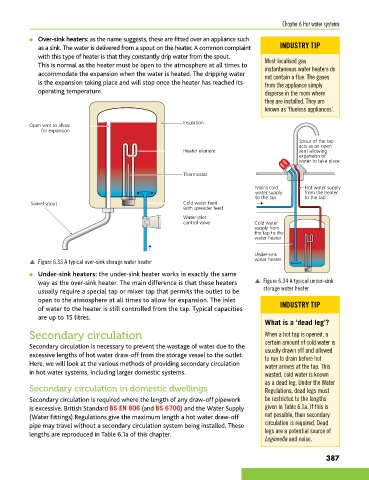
                ●  Over-sink heaters: as the name suggests, these are fitted over an appliance such
                   as a sink. The water is delivered from a spout on the heater. A common complaint   INDUSTRY TIP
                   with this type of heater is that they constantly drip water from the spout.   Most localised gas
                   This is normal as the heater must be open to the atmosphere at all times to   instantaneous water heaters do
                   accommodate the expansion when the water is heated. The dripping water   not contain a flue. The gases
                   is the expansion taking place and will stop once the heater has reached its   from the appliance simply
                   operating temperature.                                                   disperse in the room where
                                                                                            they are installed. They are
                                                                                            known as ‘flueless appliances’.

                                                                  Insulation
                Open vent to allow
                    for expansion
                                                                                                       Spout of the tap
                                                                                                       acts as an open
                                                                  Heater element                       vent allowing
                                                                                                       expansion of
                                                                                                       water to take place

                                                                  Thermostat

                                                                                         Mains cold      Hot water supply
                                                                                         water supply    from the heater
                                                                                         to the tap      to the tap
                Swivel spout                                      Cold water feed
                                                                  with spreader feed
                                                                  Water inlet
                                                                  control valve          Cold water
                                                                                         supply from
                                                                                         the tap to the
                                                                                         water heater

                                                                                         Under-sink
                p  Figure 6.33 A typical over-sink storage water heater                  water heater
                ●  Under-sink heaters: the under-sink heater works in exactly the same
                   way as the over-sink heater. The main difference is that these heaters   p  Figure 6.34 A typical under-sink
                   usually require a special tap or mixer tap that permits the outlet to be   storage water heater
                   open to the atmosphere at all times to allow for expansion. The inlet         INDUSTRY TIP
                   of water to the heater is still controlled from the tap. Typical capacities
                   are up to 15 litres.
                                                                                            What is a ‘dead leg’?
                Secondary circulation                                                       When a hot tap is opened, a
                                                                                            certain amount of cold water is
                Secondary circulation is necessary to prevent the wastage of water due to the   usually drawn off and allowed
                excessive lengths of hot water draw-off from the storage vessel to the outlet.   to run to drain before hot
                Here, we will look at the various methods of providing secondary circulation   water arrives at the tap. This
                in hot water systems, including larger domestic systems.                    wasted, cold water is known
                                                                                            as a dead leg. Under the Water
                Secondary circulation in domestic dwellings                                 Regulations, dead legs must
                Secondary circulation is required where the length of any draw-off pipework   be restricted to the lengths
                is excessive. British Standard BS EN 806 (and BS 6700) and the Water Supply   given in Table 6.1a. If this is
                (Water Fittings) Regulations give the maximum length a hot water draw-off   not possible, then secondary
                pipe may travel without a secondary circulation system being installed. These   circulation is required. Dead
                lengths are reproduced in Table 6.1a of this chapter.                       legs are a potential source of
                                                                                            Legionella and noise.


                                                                                                                387


        9781510416482.indb   387                                                                                    29/03/19   9:02 PM

